ALLAH,
HIS HERITAGE FROM PAGAN GODS
Article rescued from extinction from the Web
The name Allah is reverenced by over 1.2 billion Muslims around the world. Muslims believe that he is the same God that spoke to Abraham, David, Moses, and Jesus. But is this true? The Quran shows many of the known biblical prophets calling God ?Allah?. In the Arabic language "Allah" is supposed to be the equivalent to "God". It is very difficult to find information historically, on the name Allah before Islam. One thing that needs to be investigated is the idea or whether Allah has been thought of as the same God of the Bible, as Muslims would want us to believe. Is Allah originally Arabic? Has Allah always been known as God to the Arabs? In this synopsis, we will investigate the origin of Allah before Islam. In order to verify Islamic claims we should find evidence of their claims. This paper is an intent to be historically accurate and present the true history of Allah before Islam. Then we will investigate the character of Muhammad, for it is he who claimed that Allah inspired him which led to a new religion called Islam.
Unfortunately when one tries to search out the history of Allah before Islam, there is little or no information from the Arab point of view. The Arabs had no written history before Muhammad and the Quran is the first Arabic writing of any importance. This bodes well for Muslim who use the Hadith literature to show that Allah was the God who inspired Abraham. However the Hadith is a very late compilation and isn't present until 2 centuries after the prophet Muhammad lived. Therefore the dating of the Hadith is around the 800's which is hardly a contemporary source in verifying the life of Abraham, which lived almost 3000 years before. The name Allah isn't from Arabic nor is Allah found within the written languages of "the people of the Book". However despite the origin of the name, Allah is found in pre-islamic writings:
And
"Allah was known to the pre-Islamic Arabs; he was one of the Meccan deities." Encyclopedia of Islam, ed. Gibb, I:406.
The name Allah is pre-Islamic as we have seen and the Quran helps to verify this matter in telling Muhammad to ask the pagans, what God is supreme, etc.
However this matter still doesn't satisfy the question as to where Allah originated from. It is a historical fact that Allah was known long before Muhammad, and proof can be seen by looking at the name of his father which had "abdallah" in it. Historically there is a general consensus that Allah was a pagan deity who was worshipped along with 360 idols in the Kaaba before Muhammad and the beginning of Islam.
If you look up the definition of the word Pagan you would see that its meaning is "One who worships false gods; an idolater; a heathen". In Modern Dictionaries pagan refers to anyone who isn't a Christian, Jew or Muslim. However Pagan was the name given to idolaters in the early Christian church, because the villagers, being most remote from the centers of instruction, remained for a long time unconverted. Modern dictionaries have converted the word Pagan to include anyone other than Muslims along with Jews and Christians. But, the word Pagan applies in context to the God of the Jews and Christians, whose religions existed long before Islam. Neither Jews nor Christians consider Muslims as true believers of God. The first definition of pagan idols and gods stems from the Bible, whose God is called Yahweh Elohim. The Muslim addition is based on modern commentary and however, when investigated is historically unfounded.
The Islamic idea of Allah being the one true God is foreign in retrospect of archeological and historical evidence. Before Islam we can?t find a single shred of evidence to support the Islamic claim that Allah was just one God without partners or consorts or as the God of Abraham. Allah seems to have been worshipped with a family since his appearance in Arabia, before the birth of Muhammad. Muslims might contend that the pagan Arabs tainted the monotheistic religion of "worshipping Allah alone" by resorting to worship of idols as intercessors to worship Him. Now one must see immediately this Islamic fallacy because we must ask them this question, Which religion was pure in nature in Arabia before Islam? Also what type of inscription evidence can be presented to actually show that Allah was worshipped alone without intercessors? None. This is a later idea which developed after the founding of Islam.
We have seen that Allah is a well known deity, that existed before Muhammad and now we must investigate where the name "Allah" originated. Muslim scholars like Ceaser Farah have stated this about Allah:
This position about Allah is correct and is affirmed by more historial sources:
The complete name of Allah before it is contracted to the shorter form, is "AL-ILAH." "ILAH" is the masculine root word for Allah, or "god", in Arabic. "AL ILAT" is the feminine resulting in Allat. (Hitti, Philip, History of The Arabs, London, 1950, 8)
Historical sources say that the contraction of the name Allah means "AL-ILAH". This name is the Muslim name of the Supreme god. Muslims may say that the reference from Mr. Farah shows that Allah was the same god as EL which is found in the bible. This has led to many historical misrepresentations in equating EL with Allah. Even though both technically means "god", there is a big difference between the two. Allah falls under the catagory as a heathen or pagan deity since it isn't EL or Elohim since pagan refers to any other idol other than EL. The bible was the first book to verify what gods were idols and pagan and what were not. Neither Christians nor Jews before the inhabitants of Arabia used the term Allah to refer to the name of God. Islamist Mr. Farah continues:
Historically we see that Allah was originally a pagan deity which is later stripped of his heathanism by Muhammad. Farah finishes by saying:
This is very important to note due to the fact that Christians and Jews already considered ELOHIM as a monotheistic God who was the God of Abraham. This source from the Britannica Encyclopdia verifies this historical data:
Notice that EL is the synonym and for Yahweh, not IL. IL is found in the name Allah who is "AL-ILAH" and not "AL-ELAH". The earliest source for IL comes to us from The Babylonians. The name Babylon itself means gate of gods:
All false religion began in ancient Sumer with Nimrod. The Babylonian Pantheon is very elaborate and the city of Babylon, which is termed in the bible as THE WICKED CITY.
Shinar is located in Babylonia, which is latter kingdom that descended from the Sumerians and the civilization called Sumer. Both Babylon and Assyria are sister civilizations whose common forefathers originated from the Sumerians. The common root for virtually all Babylonian dieties is called the Dinger root.
DINGER ROOT
The term "Dinger" is a logogram that represents "god" in Ancient Mesopotamian text and language. A logogram is the function of a sign as a concept, usually represented by an entire word. The word for god in Ancient Babylon is IL(U), IL. We have already seen that Allah evolved from IL or ILU, even Muslim cited sources verify this, so now lets look at IL in action. Allah's history is highly paganistic and it's very intriguing that this name seems to orginate from the Babylonian territory, which was the origin of pagan religions. Islam picks up the same Mesopotamian traits, with Allah, in naming him the same name which can also be found in countless other dieties.
Tammuz,
the lover of thy youth.
Thou causest to weep every year.
The BRIGHT-COLORED ALLALLU bird thou didst love.
Thou didst crush him and break his pinions.
(Frazer, J G, The Golden Bough, Vol. IX, Unabr.Edition, The Scapegoat, Lond , pg. 371)
In an allegory, a poem was written centered on Gilgamesh, another Nimrod re-name. The goddess is addressed and scolded for trying to kill Gilgamesh as shown above. Note the Allalu in the above poem:
The Dinger root or "IL" is present in this name and it would precede the word as a prefix in the cuneiform text. The name Allah was at work in Semitic language forms long before Muhammad and Islam. I've seen many cases in which Muslims have tried to use Alla to equal EL, or Elah or Ela, but history shows that Allah god forms were known at the time of EL and Elohim. The Bible considered these to be idols and pagan gods. The Islamic idea of Allah being the one true God and Abraham's God is foreign in light of archeological and historical inscription evidence.
Common epithets of ?El
Bull El / God - th?ru
?ilu
El at the sources
of the two rivers - 'ilu mabbuk nahar'mi
Father of Humanity - 'abi ?'adamu
The Creator
of Creatures - baniyu banawati
The Ageless
One who Created Us - dordoru dykeninu
Kindly/Beneficent
El the Compassionate/Sympathetic - lutipanu 'ilu du pa'idu
The King, the Father of Years/Time - malik
'abi shanima/shunemi
Biblical titles include:
'abi
'ad = "eternal father"
'el `olam, = "God/ 'El the Eternal One"
`attiq
yomin/yomayya' = "Ancient of Days,"
all of which clearly reflect the epithets of
the Ugaritic 'El.
The chief Canaanite god is El, which means simply "God," familiar as one of the names of the single god of the Bible. The linguistic root may mean "That" or "the One." He is called "Creator of all Created Things," as well as "Father of Humanity." El is therefore the prime creator god of the pantheon, although we do not currently have a Canaanite creation story. El is also the king and head of the divine assembly, the council of the gods, although He is not necessarily 'biological' father of all the deities. (Qadash Kinahnu, a Canaanite-Phoenician Temple; The Temple of the Deities - Room one, the Major Deities in the Myths of Ugarit, pg. 1-2)
It is important for us to look at the study of El due to the fact that Pagan first referred to any person worshipping a diety other than EL. This destroys the idea of El being a so-called pagan based on the original meaning of what pagan was, as we noted at above.
Despite His position as creator, El thereafter was comparatively inactive. He is described as an old bearded man and, in most stories we have, He is seated in His hall up on His mountain - between the two rivers, which are the source of the world oceans. Although He is rather remote, and not usually directly approached, El is strong, powerful and wise. He is Thoru 'Ilu, the Bull God, identified with this animal for its strength and steadfastness. Whatever happens, He conserves His dignity.
El is a major figure in most of the Ugaritic myths, in the stories of Ba`al, of Aqhat, of Keret, and of Shahar and Shalim. He is also at or near the top of the offering lists at Ugarit, figuring in all of them. Kings on Earth are referred to as Sons of ?El. ?El is also the host of the ritual feast association, the Marzeah, which among other events, sponsored an annual Feast for the Dead. (IBID)
People usually don't associate El like they do pagan deities because his characteristics are strikingly similar to Biblical concepts. The only time we do see El associated with heathen idols is due to later man made myths. If we look at the epithets of El, we see that he is a god originally without a consort, daughters or association with pagan idols. El's past is highly Biblical.
If we need His aid, we must first gain the assistance of another deity who can go to His distant palace. Frequently this is Asherah, although `Anat is often not shy to approach Him directly. But El is latipanu 'ilu dupa'idu, "the Compassionate God of Mercy." He is not easily moved to anger. The Kindly One, He blesses us and He forgives us when we do things we shouldn't. If we say we are sorry, this is usually sufficient, and He accepts this as atonement. He mourns for our pain and rejoices in our happiness.
The earliest known evidence of the worship of the Goddess Asherah goes back to Sumer, where an inscription dating from 1750 BCE was found on a monument set up by an Amorite official in honor of Hammurapi, on which She is mentioned as Ashratum, bride of Anu, an Akkadian god who corresponds to ?El as god of heaven at the source of the rivers where the two world oceans meet. (IBID)
El's consort, unlike Allah, was added on after him. The earliest is 1750 BCE, which is real late compared to El, which was known hundreds of years earlier without a consort. This is one piece of evidence that Islam has not be able to produce in their support of Allah's monotheism without any partners. The Islamic argument is to believe that Allah has always been the true god alone without providing anything to support this claim.
If we add 360 years onto 70 A.D. (note we are counting backwards toward B.C.) we see that it was around 290 B.C. that Asherah was worshipped as a consort to Yahweh, which again was real late since unlike Allah, El?s consort was later added by pagans. If you look at the epithets closely you will notice that the term god is called "ilu". This is the Mesopatamian equivalent which orignated from the god An of Sumer. An is Hamatic while El is Semitic. Even though they both mean god, neither one is linguistically related to each other as Muslim would have us to believe. Dieu in French is equal to God in English but equating these two together as being linguistically related is impossible.
Both Muslim and non-Muslim historical sources verify that the name "Allah" had a history before Islam as well as Arabia. They also verify that the origin of the name is AL-ILAH with the "IL" coming from Mesopatamia. This is the first evidence shown which links the god "Allah" to a heathen and pagan origin. The word pagan, as mentioned before, first applied to a person worshipping any other god other than EL. Both Jews and Christians followed this God and despite their differences in theology, neither would tell you that any deity whose origin stems from Sumer is the same as their God. Later works added in the Muslim to be the same like the Christians and the Jews. However this accolade falls under the fallacy of equivocation since Jews don't call God "Allah" but Yahweh Elohim. Christians are trinitarians, unlike Muslims and they along with the Jews consider Muhammad to be a false prophet. The inclusion of Islam is a strict violation of what pagan orginally meant- "anybody serving a deity other than EL".
In continuing the indepth study of the orgin of the name "Allah":
See S. Friedlander, Ninety-Nine Names of Allah (1978).
When we look at this piece of data we see that it refutes Islamic argument of Allah not being a heathen god without a family.. Notice that this source says that Arabic chronicles showed that Allah was supreme God WITH THE THREE GODDESSES AL-LAT, AL-UZZA, AND MANAT AS HIS DAUGHTERS!!! This source doesn?t say that Allah was the supreme God and was just worshipped monotheistically by himself as Muslims try and promote. It was MUHAMMAD THAT DECLARED THAT ALLAH WAS THE GOD OF ABRAHAM AND DEMANDED A RETURN TO STRICT MONOTHEISM. This is putting the cart before the horse because if Islamic arguement is correct as it claims then we are incorporating Islamic thought into pre-Islamic times without anything to prove that it is true.
The name Allah and Allat were present in Hamatic cultures of North Africa, long before the origins of Islam. However, Allah's history extends further back which we shall continue to investigate. As shown earlier, from Islamic sources, Allah was the Mesopatamian "IL", which is actually the Akkadian (Pre-Babylonian) evolution of the name "AN". Scott Nogel, Professor of Near Eastern History at the University of Washington Biblical and Ancient Near Eastern Studies, Ph.D. Cornell University 1995, verifies that IL was originally AN, the first high deity of Sumer:
The god name An comes from the civilization of Sumer, who is perhaps the first civilization in the world, although human remains from Egypt in Africa predate it.
History
Sumer was a collection of city states around the Lower Tigris and Euphrates rivers in what is now southern Iraq. Each of these cities had individual rulers, although as early as the mid-fourth millennium BCE the leader of the dominant city could have been considered the king of the region. The history of Sumer tends to be divided into five periods. They are the Uruk period, which saw the dominance of the city of that same name, the Jemdat Nasr period, the Early Dynastic periods, the Agade period, and the Ur III period - the entire span lasting from 3800 BCE to around 2000 BCE. In addition, there is evidence of the Sumerians in the area both prior to the Uruk period and after the Ur III Dynastic period, but relatively little is known about the former age and the latter time period is most heavily dominated by the Babylonians...
Religion
The religion of the ancient Sumerians has left its mark on the entire middle east. Not only are its temples and ziggurats scattered about the region, but the literature, cosmogony and rituals influenced their neighbors to such an extent that we can see echoes of Sumer in the Judeo-Christian-Islamic tradition today. From these ancient temples, and to a greater extent, through cuneiform writings of hymns, myths, lamentations, and incantations, archaeologists and mythographers afford the modern reader a glimpse into the religious world of the Sumerians. Sumerian FAQ
The echoes of Sumer found in Islamic tradition is the god root "AN" which is later identified as "IL" or "ILU". Here is the history of An in Sumerian religion:
Muslims may claim that An isn't the same deity as "Allah"--IL. However Islamic and historical sources say otherwise. What is more shocking than this is the cuneiform text themselves:
- phonetic: an, (ìl, in words related to ilum `god')
- phonetic, old: èl
- determinative: before deities and demons, transcribed as d for dingir
- examples in New Assyrian orthography:
- DINGIR.MEsh (MEsh is plurial sign) ilü '(the) gods'
-
 DINGIR.MEsh (MEsh is plurial sign) ilü '(the) gods'
 - logogram:
AN, DINGIR
AN Anu supreme god AN amû `sky', `heaven' DINGIR ilu `god''
If you look at the available text you see that the AN which is dinger, shown earlier is AN (ANU) the original god of Sumer. The AN is equal to IL which later became used as IL in ILAH. We have already verfied this from Muslim and non-Muslim sources.
The relation of this name, WHICH IN BABYLONIA AND ASSYRIAN BECAME A GENERIC TERM SIMPLY MEANING 'god', to the Arabian Ilah familiar to us in the form Allah, which is compounded of al, the definite article, and Ilah by eliding the vowel 'i', is not clear. Some scholars trace the name to the South Arabian Ilah, a title of the Moon god, but this is a matter of antiquarian interest...it is clear from Nabataen and other inscriptions that Allah meant 'the god.'
The other gods mentioned in the Quran are all female deities: Al-Lat, al-Uzza, and Manat, which represented the Sun, the planet Venus, and Fortune, respectively; at Mecca they were regarded as the daughters of Allah... As Allah meant 'the god', so Al-Lat means 'the goddess'. (Alfred Guilaume, Islam, Penguin, 1956 pgs. 6-7)
The origin of Allah which is "AN" the high god of Sumer is found in every Babylonian god and demon! Therefore if we believe the Islamic argument that Allah is the same god of the Bible, historically we must also believe that "ALLAH" or "AN or IL" was also other gods as well as demonic entities. The god AN is known as the heaven god of Sumer whose meaning also means heaven:
And
Each of the four major Sumerian deities is associated with one of these regions. An, god of heaven, may have been the main god of the pantheon prior to 2500 BC., although his importance gradually waned. (IBID, p. 118)
The origin of An (later IL) is heaven which is also a synonym of LIL, which in turn means atmosphere or air, another definition of heaven. Both Allah and Allat have the "IL" or "AN" roots present in the makeup of their names, which clearly shows us that both originated from heathen deities in Sumer. Since Allat was busy in Babylonian inscriptions and cuneiform accounts, we know very well that Allah was on hand at least as a grammatical "other". J J M Roberts, in his list of god / goddess names has shown very clearly that:
Many Muslims have argued that the name Allah is Arabic but this is historically unfounded since An is IL from Sumer where Arabic was never spoken. Another unfounded claim is the idea that the Kaaba was originally a monotheistic place for worship.
One thing that is very interesting is the idea of the Kaaba being built by Abraham. This theory isn't found anywhere in Arabia prior to Islam. If we are to believe the claims of the Quran and Hadith literature, how come that there is no evidence in support of this assertion also? Even Muhammad never mentioned that the Kaaba was built by Abraham until after the advent of Islam. The inscriptions found in Arabia dealing with both the Kaaba and Allah, show heathen and paganism and nothing more. Therefore we are left only with the unprovable claims of Muslims, the Quran and the Hadith.
All of Muhammad?s ideas about the Kaaba and the god-name Rahman can from ancient Arabian paganism. Muslims basically claim that Allah is the true god because he was the supreme God of Arabia. Anu was the supreme god of Sumer but I wonder would Muslims call him the true god too? No they wouldn't. However, history does show that Allah's "IL" root stems from the very god mentioned, An of Sumer.
We know that Allah isn?t the same God as El because both were known by the people of that time. How could the two be the same when El is ?EL? and Allah is ?IL? derived from ?An?. The Islamic argument of trying to equate IL to EL isn?t true because IL has been historically shown to be ?AN? first. Also since Semitic cultures added suffixes to the God names ex. AH to IL to = ILAH, how come EL suffixes are El-OAH and EL-OHIM? Because Allah was the high god doesn't make him the same God of the Bible. Using that methodology, every other high god in religions of other cultures are considered the one true god, or in Muslims case, Allah also. Our Muslim apologist would be quick to interject but however this same method was used to make Allah the so-called God of Abraham. Allah has had a relationship to other notable high god deities some are recognized from this historical source:
Another intruiging factor is shown by the Babylonian "Halla" which is later found in Arabia. In South Arabia, it is HLH in writing inscriptions. Let us look at one long bridge as reported by Hitti. He shows that the Arabs of Saba in South Arabia inscribed HLH in some of their inscriptions for the high god.
This certainly shows us that Allah and AN of Ancient Sumer carried the same divine heritage and survived in the minds and writings of the Arabs indeed to the Indian ocean and Zanzibar. Also notice that when IL-hallabu reached Arabia it lost the "BU" to become Allah. In the Sumerian language, words are written from left to right, however in Arabic words are written from right to left. If you right Halla from right to left beginning with the first letter from that side, or backwards it is Allah! However before it became Allah it was Hallah first.
One incriminating fact against Allah's monotheism as well as being the God of Abraham, as Muslims claim, can be seen from studying the account of Herodotus, who visited Arabia in the centuries predating Islam:
BACCHUS THEY CALL IN THEIR LANGUAGE OROTAL, AND URANIA, ALILAT. . . .
There is a great river in Arabia, called the Corys, which empties itself into the Erythraean sea. (Herodotus, Translated by J Enoch Powell, pg. 200 1949)
Where is the name ?Allah? at? If Allah was such a well-known deity, how come we find no such mention of him as the one true god and the God of Abraham? Simple, Allah was just one of the many other deities and only Muhammad promoted him to be the same God of the Bible. Even in the earliest accounts of Pre-Islamic Arabia, we find no mention of Allah being the NAME OF THE SUPREME GOD nor the God of Abraham. Alilat is the Babylonian name of Allat!!! This is shown from the Pre-Islamic Arab language, mentioned by Herodotus!!! What was Orotal? Here is what he was:
History clearly shows us that the Babylonian pantheon was still prevelant thinking in Arabia, long before the founding of Islam, which is easily seen from the name of Hallah. This isn't shocking at all since a good majority of the 360 idols present in the kaaba originated from Sumer, including Allat. Allah was the exact unquestionable linguistic male gender compliment of Allat, with suffix gender distinctions on the IL or AN root. In his Semitic Mythology, Langdon indicates that
This shows the linguistic variation caused by migration along the trade routes from Phoenicia, Assyria, Babylon, and Sumer.
Babylonian goddess worship saturated Arabia, there is no evidence to prove that Allah was never worshipped without any family. This seems to be the later invention of Muhammad who later decided that Allah had to be the god of Abraham. The daughters and consorts of Allah were worshipped extensively in Arabia. There is no evidence that any Muslim can show you in claiming that Allah wasn't originally pagan.
If you look at this evidence closely we see that the kaaba itself was also a black uncut stone. History has shown us that the Kaaba may have first been a sign of goddess worship. However no proof before Islam exist to verify that the Kaaba was originally monotheistic. We will deal with that issue in greater detail, later on. We saw earlier that Allah and Allat were called Hallah and Hallat respectively, this disproves the Islamic idea about the name Allah never evolving from any previous god names. Even in Arabia, Allah was called Hallah first. Muslim's who try an argue and claim that the "AL" differentiates the ILAH to make Allah and therefore makes Allah the true god must explain to us why Allah in Arabia wasn't Allah but Orotal, Hallah, etc. None of the examples use the Arabic "AL" or "THE" to differentiate the god name. This argument is also disproven by the archeological evidence found in the Arabian penisula itself.
This shows that Allah was well established in North Arabia and that he had a consort, or lady friend of high esteem, named Allat. Also notice that the HLH which is Hallah was originally used. We've already seen that this name did originate from Babylon, just east of Arabia.
History, contrary to bias Islamic claims clearly shows us that Allah before Islam was no more than a heathen deity, who was never addressed by the Arabs as the God of Abraham.
Her consort Allah was simply the god who impregnates the earth.
(Langdon, Stephen H, The Mythology of All Races, Vol V, Archeological Institute of America, Boston, 1931 pg. 5-19)
The
origin of Allah and Allat were as sun and moon deities.
(Zwemmer, (Ed) The Daughters of Allah,
By Winnett, F V, MWJ, Vol. XXX, 1940, pg. 120-125).
Each Arabian tribe adopted their own form of Babylonian deity and Allah is no exception. Extensive study into the history of Allah shows nothing more than a pagan god and nothing more. From it's origins of the god An in Sumer, Allah has seemed to have kept his high god status all the way to Mecca. We must reiterate again that both the Mesopotamians like the Arabs use the god name for virtually every deity. We will look into that in greater detail also.
--the supreme of a pantheon of gods.
--THE NAME OF A god whom the Arabs worshipped.
--the chief god of the pantheon.
--Ali-ilah, the god, the supreme.
--the all-powerful, all-knowing, and totally unknowable.
--the predeterminer of everyone's life) destiny).
--chief of the gods.
--THE SPECIAL DEITY OF THE QURAISH.
--having three daughters: Al Uzzah (Venus), Manah (Destiny), and Alat.
--having the idol temple at Mecca under his name (House of Allah).
--THE MATE OF ALAT, the goddess of fate.
(Afshari, M. J., Is Allah The Same God As The God Of The Bible?, pg. 6)
There is no documented history of Allah's singularity. All we see is that Allah was a high god with 3 daughters, while being the incestual mate of another one, ALLAT. We must wonder why is there nothing ever found to prove that Allah was never worshipped as a god without any consorts? The only thing Muslims try an use to offer in promoting Allah's monotheism is the Quran. But the Quran isn't from pre-Islamic Arabia and is neither a witnesses or an authority in pre-Islamic Arabia. Also notice that Allah was the name of A GOD, not the name of THE GOD OF ABRAHAM. This Muslim argument about this matter is lacking any historical support. This factor is very intruiging indeed.
If we are to base Islamic argument on the idea of "Allah" being the true God because he is the high god, then every other culture who has a high god is also the same as the true god. Is Zeus the word for god in Greek? No it's theos, Is Brahman the name for God in India? No. Muhammad took the high god name "Allah" and called him the God of Abraham because it was his favorite deity as well as the special deity of his tribe, the Quraish.
Muhammad and the name
Allah
If Muhammad originally thought of Allah as Muslims do today and would want us to believe that he did, why would he try to change the name of a god who was supposed to be the Almighty? The Quran nor the Hadith literature says anything about this matter and we wonder why is there no mention of this? When Muhammad spoke the Satanic verses he was visited by Gabriel and was told about his mistake, but would God allow a human man to take his name and then change it to what the man wants it to be? Blasphemy.
From this we have seen that the name Allah has been retained basically because Muhammad was afraid to offend any tribe. That means both the name Allah and the origins of Islam comes from the thinking and idea of the Prophet. It would literally be unimaginable if we saw any biblical prophets try to change the name of God. It would cause an uproar. However we don't see anything like this with Muhammad. If the Arabs knew that he would change the name of the so-called Almighty God they would surely be angry at Muhammad. This shows us that Allah was not really considered the god of Abraham but just the usual supreme deity found in every heathen culture on earth since the beginning of time.
Islamic Sheikh, Ibrahim Al-Qattan, in a lecture given to the International Progress Association in Vienna, said:
Now if the Quran says not to take Jews as friends then why is Muhammad using a name by PAGAN JEWS?
We don?t see Elohim, the God of the Jews, mentioned here but a pagan deity called Rahman. This same pagan deity was called Allah and was later used by Muhammad in the Quran! These traders were described as being pagan and if since they were Jews we would expect to see EL, Yahweh or Elohim mentioned as the name of God. However these Jews were pagan and their high pagan god was name Allah. This should be a note to us all in telling about how Allah has nothing to do with Elohim and that the original concept dealing with the Jewish God is non-existent since these Jews never called Allah the God of Abraham but extoled Rahman, a idol, who is mentioned in the Bible as being the god Rimmon. More on this later.
Many other deities were known as Allah and in order for us to believe the Islamic argument that Allah was always the one true god. Then we must also believe that the other gods he was is also the same god. Muslims may claim that the other deities were wrong and therefore should be discarded but however this is based on mere opinion. If we use this same argument with the people who worshipped these other Allah deities, they would claim that the Islamic idea of Allah is also wrong. Hence we would be drawn into an endless circular debate about which deity is the true Allah. Since historically neither claim can be verified we are left with basically conjecture. However we will look at some of these other deities which used the name Allah also.
Allah is also known as Qos-allah but one thing that is very interesting is the part in which the star crescent is found before Islam in Petra. This symbol was first used as symbol of a older pagan deity. Ironically this deity also had the name Allah and just like the modern version used the crescent star. Muslims who attack other religions as being pagan should really be careful since historical inscriptions are showing also that Islam did clearly descend from a pagan heritage.
More and more historical evidence proves that Allah isn?t an Arabic word, and was a pagan deity by looking further into history. Persia (Modern-day Iran) has existed long before Arabia and Islam.
This is a very important step for us to note since the Quran does contain many Persian words and Islam also has many Persian-like practices. What is more revealing than that is this:
The Persians were clearly a pagan culture and it is interesting that the name Allah, the same of Islam is used as one of the many pagan Persian deities. If Muslims try to interject and claim that Allah was known as the true god and found his way to Persia then they are required to produce their proof if they are truthful. History however will disprove that claim since nowhere is it mentioned before Islam in Persia or Arabia in which Allah was known as the same God of the Jews but in a different name due to culture.
Muhammad Prophet of God?
The man responsible for promoting Allah is Muhammad. He claimed that God?s name was Allah and everybody just took his word for it. Muhammad is propogated by both Muslim, the Quran and the Hadith to be a prophet as well as the seal of prophets. However, when we examine Muhammad closely we will see that he is the furthest thing from a prophet. Now lets examine Muhammad to see if we should trust what he claims.
The commencement of the Divine Inspiration to Allah's Apostle was in the form of good righteous (true) dreams in his sleep. He never had a dream but that it came true like bright day light. He used to go in seclusion (the cave of) Hira where he used to worship (Allah Alone) continuously for many (days) nights. He used to take with him the journey food for that (stay) and then come back to (his wife) Khadija to take his food like-wise again for another period to stay, till suddenly the Truth descended upon him while he was in the cave of Hira. The angel came to him in it and asked him to read. The Prophet replied, "I do not know how to read." (The Prophet added), "The angel caught me (forcefully) AND PRESSED ME SO HARD THAT I COULD NOT BEAR IT ANYMORE. He then released me and again asked me to read, and I replied, "I do not know how to read," whereupon he caught me again AND PRESSED ME A SECOND TIME till I could not bear it anymore. He then released me and asked me again to read, but again I replied, "I do not know how to read (or, what shall I read?)." Thereupon he caught me for the third time AND PRESSED ME and then released me and said, "Read: In the Name of your Lord, Who has created (all that exists). Has created man from a clot. Read and Your Lord is Most Generous...up to..... ..that which he knew not." (96.15)
Then Allah's Apostle returned WITH THE INSPIRATION, HIS NECK MUSCLES TWITCHING WITH TERROR till he entered upon Khadija and said, "Cover me! Cover me!" They covered him till his fear was over and then he said, "O Khadija, what is wrong with me?" Then he told her everything that had happened and said, 'I fear that something may happen to me." KHADIJA SAID, 'Never! But have the glad tidings, for by Allah, Allah will never disgrace you as you keep good reactions with your Kith and kin, speak the truth, help the poor and the destitute, serve your guest generously and assist the deserving, calamity-afflicted ones." Khadija then accompanied him to (her cousin) Waraqa bin Naufal bin Asad bin 'Abdul 'Uzza bin Qusai. Waraqa was the son of her paternal uncle, i.e., her father's brother, who during the Pre-Islamic Period became a Christian and used to write the Arabic writing and used to write of the Gospels in Arabic as much as Allah wished him to write. He was an old man and had lost his eyesight. Khadija said to him, "O my cousin! Listen to the story of your nephew." Waraqa asked, "O my nephew! What have you seen?" The Prophet described whatever he had seen.
WARAQA SAID, "This is the same Namus (i.e., Gabriel, the Angel who keeps the secrets) whom Allah had sent to Moses. I wish I were young and could live up to the time when your people would turn you out." Allah's Apostle asked, "Will they turn meout?" Waraqa replied in the affirmative and said: "Never did a man come with something similar to what you have brought but was treated with hostility. If I should remain alive till the day when you will be turned out then I would support you strongly." But after a few days Waraqa died and the Divine Inspiration was also paused for a while and the Prophet became so sad as we have heard that he intended several times to throw himself from the tops of high mountains and every time he went up the top of a mountain in order to throw himself down, Gabriel would appear before him and say, "O Muhammad! You are indeed Allah's Apostle in truth" whereupon his heart would become quiet and he would calm down and would return home. And whenever the period of the coming of the inspiration used to become long, he would do as before, but when he used to reach the top of a mountain, Gabriel would appear before him and say to him what he had said before. (Ibn 'Abbas said regarding the meaning of: 'He it is that Cleaves the daybreak (from the darkness)' (6.96) that Al-Asbah. means the light of the sun during the day and the light of the moon at night). Quoted from the Sahih (authentic) Hadith (traditions) of Bukhari, Volume 9, number 111.
Keep these highlighted parts in mind, they will be very usefull as we go along. We see that the Angel pressed poor old frightened Muhammad and forced him to read. One thing to note is the fact of why the angel didn't know that Muhammad was illiterate? Surely Gabriel wouldn't tell a man to read and who couldn't read. Also, notice that this so-called angel never claimed to be Gabriel! This came later on. His uncle Waraqa said it was Gabriel, not Muhammad. Why didn?t Gabriel mention his name to Muhammad? Again, how come Gabriel told Muhammad to read when he was illiterate? Waraqa, a so-called Christian, is wrong too, because Gabriel never appeared to Moses. Even the Quran says that Allah appeared to Moses. What does this mean? It means that the beginning of Muhammad?s call was based on error. 1.) The spirit never said it was Gabriel (this came later) 2.) Muhammad never claimed it was Gabriel, let alone an angel 3.) Waraqa said this Gabriel appeared to Moses when it was ?God? who appeared to Moses.
Lets look at people who?ve encountered visits with God as well as Gabriel in the Bible.
Noah - Gen. 6.
God speaks to Noah and tells him that He is going to destroy the earth. Noah does not panic, become depressed, or driven by fear. He knows that this God speaking to him, and there is no need for rash action. Noah knows this is God, and Noah does not become irrational. Noah knows that this God is not going to harm him.
Abraham - Gen. 12 - 18.
God speaks to Abraham. Abraham does not panic, Abraham is not bewildered, Abraham does not doubt or become depressed, Abraham believes and obeys. God visited Abraham, yet neither he nor Sarah attempts any rash actions.
Moses - Ex. 3 - 34
God appeared to Moses in the burning bush. Moses was afraid to look at God but Moses does not act paranoid. He knew that this God was not a God of terror. Moses did not run back to his family frightened out of his mind. Moses did not become depressed over the event, thinking he was possessed or bewitched. Instead, because Moses personally experienced this God and knew he could trust this God, Moses knew and obeyed.
Isaiah - Isaiah 6
Isaiah had a vision of God
Isaiah had a powerful vision and experience of God. Yet he did not lose his mind, he was not driven by dread of God. He feared God because of the sin in his heart, and the sinfulness of the people he dwelt among, but he did not panic. During this experience he realized God had forgiven him and accepted him. Because he experienced the real God, Isaiah did not attempt suicide or any other rash action. His mind was sound, he did not need to have a "spirit" continue to sooth him.
Mary - Luke 1.
The real Gabriel also visited Mary. She too was perplexed and afraid. But during her experience with Gabriel, she gained confidence and strength. She knew God loved her. She did not become irrational, she did become depressed, and she did not run around frightened out of her mind. She did not attempt suicide. Instead, because she experienced the living God, she knew she was loved and accepted. She knew this God was real, and she had nothing to fear.
As we read the stories about people in the bible who encountered God I do not find anything that resembles Muhammad's experience. These people actually met God, while Muhammad's entire prophet hood rests only upon what a spirit / angelic interface told him. These people were filled with a reverent fear, but never became depressed as a result of their experience. These people fellowshipped with God. Some walked with Him, to other's He revealed Himself. None of them ever contemplated suicide. But several times over a course of up to three years, Muhammad tried to commit suicide, and each time this "spirit" stopped him. What plans did this spirit have in store for him?
Oh the other hand, examine Judas. Satan put it into his heart to betray Christ; Satan entered Judas. And, when Judas came to his facilities, he committed suicide. When Muhammad had period of clear thought, without the influence of a spirit, he tried to do the same thing - kill himself.
None of these people experienced suicidal thoughts, so why should we accept a man who even admitted that ?woe is me poet or possessed? dealing with the name of God? Look at Judas Iscariot, Satan persuaded him to betray Christ; Satan entered Judas. When Judas came to his facilities, he committed suicide. When Muhammad had a period of clear thought minus the influence of the spirit, he tried to do the very same thing--- kill himself! Ladies and gentlemen, this is the great Apostle of Allah, a frightened poor little man. Yet Muslims follow the idea of this man who called himself ?a poet? and then try to tell us that Allah is the same as Yahweh.
When we continue to examine the character of Muhammad we find that he was the furthest thing from a prophet. Lets look at the life of Muhammad before his alleged claim to prophethood.
Isn't this interesting. This quote says:
It is a known fact that Muhammad himself was a pagan, before he alleged revelation from Gabriel. What should be noted is that he was not just a pagan, but a mystic who first considered himself as a Shair. Because of his pagan heritage, Muhammad even allowed pagan practices to remain in the Quran:
Despite the fact that the parenthetical statement "to the pagans" is not part of the Arabic text, the point is still clear that Muhammad ate food sacrificed to idols that Zaid refused to partake. The Quran itself commanded Muslims to continue practicing the pagan rites as part of the religion:
Hence, we clearly get a picture of how Muhammad's mystic background affected his way of thinking. Why would God say that pagan rites, from time memorial isn't wrong? Muslims may claim that these were first the practices of Abraham, but none of this came until the Hadith literature. The fact that Muhammad himself didn't even considered these rites, practices of Abraham also strikes us as being pecular. Since the Quran, by Islamic claim was revealed to Muhammad by Gabriel, we must continue the study of both him and Muhammad. Let is continue after Muhammad's first vision:
Muhammad's religious experience obviously wasn't the same experience that the Biblical prophets and other figures had with Gabriel, nor were those people mystics like the prophet of Islam. We also note that:
Here is where the differentiation between Muhammad and the Biblical prophets comes in. In the Hadith we saw that Muhammad used to have a "form of good righteous (true) dreams in his sleep." Before this time we must note that Allah hadn't personally been revealed to Muhammad, this came later on. Note this from a site on Shamanism:
Muhammad's Shamanistic behavior is very evident in the Hadith. Although he didn't have any visions of the dead, we do know that Muhammad did claim to have gone to the furthest mosque, which Muslims claim was the Al-Asqa in Jerusalem. This is clear Shamanistic visions, which were propogated to be prophetic. This falls under the criteria of a shaman traveling to far-away places. The evidence is clearly seen from Muhammad's background as a mystic, who in Arabia, were nothing more than pagan worshippers.
Muhammad's prophetic call is very pecular and interesting to study about. When we continue to examine the mystic's prophetic call from authentic Islam traditions, it becomes more apparent that his calling is more and more occultic and indulges heavly into psychic phenomenon. There are more reports which make the careful reader aware of the occult and shamanistic background of Muhammad's calling.
Obadah-b-Swamet reported that when a revelation came unto the prophet, he used to become greatly perturbed and his face became changed. (Mishkat IV, p. 259)
And,
If you read the Bible you notice that no prophet ever had these weird experiences. We must wonder why would Muhammad's mother need to use a magical spell to heal him from the evil eye? From his early childhood, we find out that Muhammad was a very trouble kid. Muslims usually don't mention anything about Muhammad's past in trying to convert people to Islam. They blindly follow the Quran but they have yet really examine Muhammad. How do we know that the Quran might not have been inspired by a evil spirit? Because it said so? A evil spirit can say anything also including saying that it isn't evil. Basically Muhammad's childhood and his prophetic experiences relate anything but a spirit of God visiting him. However, Muhammad's childhood and calling still continues to verify its shamanistic origin:
From examining the Islamic traditions this spirit that appeared to Muhammad does the exact samething, like a spirit would appear to a shaman. Muslims might claim that this is also the same case in the bible but the difference with Muhammad, in accordance to the shamanistic experience was that he experienced torment for not immediately accepting the spirit's revelation about him being the apostle of Allah. Look at the quote about Muhammad's sickness again:
This illness came right after the ecounter with the spirit in the cave. This is common shamanistic illness followings these types of encounters. For Muslims to claim otherwise then they must intentionally ignore the facts about Muhammad. If they claim that Muhammad is a prophet, why is his experiences fitting virtually perfect with shamanistic encounters? No prophet in the Bible had these types of experiences. They never became sick after talking to an angel of God nor were they ever known to have bizarre childhood experiences which required spells to heal them. Islamic authorities were correct when they claimed that Muhammad had shamanistic encounters.
This is absolutely amazing! Muslims call a man who foamed at the mouth a prophet. This is an ugly site and anybody seen in today's society would be considered insane or mentally sick, if they constantly foamed at the mouth. If you saw Muhammad in this situation you'd think that he had rabbies! Roaring like a camel? This is clear demonic traits since no normal prophet ever roared like a animal in the the Bible. The characteristic of swooning was considered by biblical prophets to be demonic. One must wonder why only notable traits, found in common medium trances, are seen in Muhammad's prophetic encounters? Should we ignore all of this and claim that Muhammad was a prophet of God, though he had these experiences because Muslims want us too?
Muslims who try to reject the demonic nature of Muhammad's inspirational experiences, first have him to thank for propogating this belief. When we continue you to study Muhammad's prophetic inspiratation we find out that:
Again we cleary see that Muhammd's experiences were nothing more than mere medium experiences which is considered an abomination in the Bible. Many mediums consider themselves as prophets but should we take their word for it because they said so? Muslims would say no, but they did the same thing with Muhammad. What makes Muhammad so special from any other Shaman or Medium? Because he brought God's final message? The Bahai prophet and Joseph Smith of the Mormons claimed to have done the same thing "bring God's final message". So basically Muslims are left with nothing more than circular arguments by claming that Muhammad was a prophet. Hence, when you examine Muhammad you find out that he is far from being a prophet but considered more as a spiritist who indulged in shamanistic experiences:
So using the Islamic method, should we consider them prophets? All of these people experience the same experiences similar to Muhammad. The Quran might tell us to reject them but this is just one piece of channeled literature telling you not to follow other channelers. This seems more like petty jealousy found in today's mediums who operate for profit and who don't want to lose their clients to other competing soothsayers.
The Quran falls easily under this category. Muhammad experienced excrutiating torment throughout his life by spirits, but yet he seemed to have hated Christianity's idea of atonement through the cross. This will be discussed later. More evidence showing that Muhammad was having shamanistic experiences can be seen from this tradition:
Not only was Muhammad's experiences strange, they also seem to endow him with supernatural strength. Is this also a characteristic of Shamanism? Yes it is:
Islamic history shows that Muhammad's soul departed his body, a clear trait in Shamanism. Also notice that Muhammad always quivered, raged and roared before an alleged revelation. These experiences were forms of Shaman ecstacy and the acceptance of the spirit's claim that he was an apostle of Allah also verifies this. In the revealing of the Quran, the spirit always used Muhammad as a mouthpiece to voice itself.
Muhammad's superhuman strength, is shown when he was able to sit atop the camel and then force it to its knees. Muhammad's shamanistic experiences also left him mentally disturbed many times. We must wonder why would God allow a person to suffer so much just to reveal things through him while other previous prophets were clearly able to speak his words without falling into these extravagant ecstatic behaviors?
If we look at all this information, a picture begins to form. Anyone acquainted with occult phenomena has become aware of certain happenings that may be expected at a seance. Occult phenomena in childhood, daydreams, the hearing of voices and calls, nightly meditations, excessive perspiration during trance and the subsequent exhaustion and swoonlike condition - even the ringing of bells, are not uncommon. The condition that looked like intoxication is revealing. Anyone being in a real reasonable deep trance has that look. Muhammad had experiences which coincide perfectly with occultic and shamanistic experiences. There is no evidence whatsoever, other than his own claim, in proving that Muhammad is a prophet.
The noted Quranic translator Rodwell observes:
Muhammad's problems began earlier with his mother and continued on through him. Maybe his mother dropped him on his head too many times, which altered is brain. A man like this, who has hallucinations is only viewed as inspired by ignorant people. That right there speaks for itself. We see that Muhammad and his claims or prophethood developed among the throngs of the ignorant. No Muslim would want to be taught in school by a ignorant person, but however Islam itself is based on the judgement of the ignorant. At least all of the Biblical prophets could read and write, something which is highly embarrassing when we factor this with Muhammad, who was illiterate.
Muslims may try to claim that Muhammad's experiences weren't really like this but we have shown extensively that the alleged prophet of Islam experienced stranged and bizarre behavior. Early biographers state that Muhammad had strange experiences while he was being cared for by his wet-nurse, Halima. On one occasion he fell down in a kind of stroke and when he finally stood up his face was quite livid. Ibn Ishaq states that two men clothed in white had seized him and opened his chest.
The myth around the story is that two angels took out his heart, cleansed it of impurity, and replaced it in his body! Other traditions say the cleansing and removing of Muhammad's heart happened just before the mi'raj. When the story is stripped of its fanciful features, one is left with a record of psychic experiences occurring during Muhammad's youth. Here is a Hadith talking about this experience from Bukhari:
Volume 5, Book 58, Number 227:
Narrated Abbas bin Malik:
Malik bin Sasaa said that Allah's Apostle described to them his Night Journey saying, "While I was lying in Al-Hatim or Al-Hijr, SUDDENLY SOMEONE CAME TO ME AND CUT MY BODY OPEN FROM HERE TO HERE." I asked Al-Jarud who was by my side, "What does he mean?" He said, "It means from his throat to his pubic area," or said, "From the top of the chest." The Prophet further said, "He then took out my heart. Then a gold tray of Belief was brought to me and my heart was washed and was filled (with Belief) and then returned to its original place. Then a white animal which was smaller than a mule and bigger than a donkey was brought to me." (On this Al-Jarud asked, "Was it the Buraq, O Abu Hamza?" I (i.e. Anas) replied in the affirmative). The Prophet said, "The animal's step (was so wide that it) reached the farthest point within the reach of the animal's sight. I was carried on it, and Gabriel set out with me till we reached the nearest heaven...
Muslims may try to allegorize this passage, but that can't be due to the nature, that Muhammad believed that it truely happened. If they allegorize this passage then they must also allegorize Muhammad's travel to the furthest mosque. However, this experience also cast a shadow on Muhammad's prophethood since this also another characteristic of Shamanism:
This quote is almost perfect in describing Muhammad's experience to heaven. Notice that Muhammad already accepted the call by the spirit so-called Gabriel, which is in accordance with a shaman, then he is cut in his body and has his heart removed before ascending to heaven where he meets supernatural beings. The minor differences is that Muhammad's heart is removed instead of his bones and that the spirit and not any other human person introduces Muhammad to the people of heaven. (Note: The prophets have already passed away and the term supernatural refers to a spirit. A person is natural but their soul is supernatural because it is a spirit. We are not saying that the prophets, with the exception of Jesus, was supernatural). Also the spirits don't always count the shaman's bones, this is just a well-known metaphor used to describe the many cases in where other things are perhaps removed from the body. This quote verifies this as well gives us more explanation of Muhammad's experiences:
The Sahih Hadiths and the Quran clearly show that the spirit appeared to Muhammad and claimed that he was chosen, much like a shaman, we also see that Muhamamd encountered all of this shamanistic experiances during his adolescence, which again is verified by authentic Islamic traditions. This clearly shows us that this spirit chose Muhammad long before he knew what he was going to be. This is totally different from Biblical inspiration due to the fact that God never tortured anybody with symptons like these. We must wonder why would he start now with the revelation of the Quran? This is something that is very odd indeed.
It is also a very well-known fact, despite Muslim objection, that Muhammad did suffer from epiletic behavior. Some Islamic apologists claim that epilepsy leaves the victim without memory and therefore can't refer to Muhammad. However this is mere conjecture and is only partially true since both the Quran and the Hadith verify that Muhammad did forget many of the revelations giving to him:
This is later changed in Surah 17:86-
Since epilepsy leaves the person forgetful, we wonder why is both Muhammad and Allah forgetting? Allah claims that his word can't be changed but yet he forgets this and claims that Muhammad can also forget after claiming that he doesn't let him forget. We do know from authentic traditions that Muhammad did had epilepsy when he went to live with his uncle Abu Talib at the age of 8. One fascinating thing about this matter is that Muhammad is named as one of the world's most famous people with this disease mentioned as his disablility:
Arab prophet and founder of Islam, 1622. Prophet of Allah. Wrote The Koran. Considered by most Muslims to have been sinless. {4,85} http://www.hillsboroughcounty.org/agencies/acd/fpdp.html
This list was composed by a whole host of people including medical doctors specializing in Medical practices. It should be noted that different types of seizures occur which closely resemble epilepsy. Nevertheless it can also be said that anyone who is subject to occultic influences, like Muhammad does have these types of fits and instead of forgetting does remember what happens. This is a known fact throughout the world and is not uncommon at all among Mystics, such as Muhammad, and is widely reported. Since we know that Muhammad's experiances were in tune more to occultic experiances, we know that this is the reason for his continous torments throughout his life. Jesus healed people like this in the New testament.
During the life of Jesus a young boy was brought to him who was "an epileptic" (Matthew 17.15) and who suffered extreme forms of epilepsy (he would suddenly fall down, be convulsed. and be unable to speak). There is no doubt, however, that this epilepsy was not naturally but demonically induced as all three records of the incident (in Matthew 17, Mark 9 and Luke 9) state that Jesus exorcised the unclean spirit in the child and healed the boy. We can safely say that Muhammad needed Jesus.
Who is this Gabriel?
Muhammad is claimed to have received a message from Gabriel claiming that he was the prophet of Allah. The Qur'an describes these manifestations in striking language:
- For he appeared (in stately
form) while he was in the highest part of the horizon; then he approached
and came closer, and was at a distance of but two bow-lengths or (even) nearer;
So did (God) convey the inspiration to His Servant - (Conveyed) what He (meant)
to convey. The (Prophet's mind and) heart in no way falsified that which he
saw. Will ye then dispute with him concerning what he saw? For indeed he saw
him at a second descent, near the Lote-tree beyond which none may pass: near it
is the Garden of Abode. Behold, the Lote-tree was shrouded (in mystery unspeakable!).
(His) sight never swerved nor did it go wrongs! For truly did he see of the Signs
of his Lord, the Greatest! Surah 53.6-18.
In another passage the Qur'an again states explicitly that Muhammad had a definite vision: "And without doubt he saw him in the clear horizon" (Surah 81.23). Another verse states clearly that the vision was given by Allah himself: "We granted the Vision which we showed thee" (Surah 17.60). The confident manner in which Muhammad claimed that he had had at least two definite visions strongly suggests that he really did see a strange being on the horizon. He described the second vision in these words:
"Once while I was walking, all of a sudden I heard a voice from the sky. I looked up and saw to my surprise, the same Angel as had visited me in the cave of Hira. He was sitting on a chair between the sky and the earth. I got afraid of him and came back home and said, Wrap me! Wrap me!" (Sahih al-Bukhari, Vol. 6, p. 452).
Muslims vehemently claim that it was the angel Gabriel who came to Muhammad, yet the Qur'an only once refers to Jibril as the medium of the revelation (Surah 2.97) while stating elsewhere that it came down with the Ruhul-Amin, the Faithful Spirit (Surah 26.193). The identification of Gabriel as the Qur'anic messenger is significantly only made in a very late passage of the Qur'an after Muhammad had had many dealings with Jews and Christians. This spirit never identified himself as Gabriel when Muhammad first met him. Waraq first claimed this and then the spirit ironically claimed this. Also since the name Gabriel came in a very late passage of the Quran, this shows us that Muhammad didn't originally believe Waraqa's claim. He had to be around the Jews and Christians before finally deciding that it must have been Gabriel. A telling story indeed.
This explains why Muhammad thought he was demon possessed, or influenced by demons; the Quran in many places reads like typical Arabic poetry. These supernatural spirits or demons were called Jinn. We see that in the Quran, Satan was ONE OF THE JINN! Hmm, very interesting because if we are to accept Muhammad?s claim about Allah being Yahweh then it is imperative for us to look deeper into this matter.
Notice in the Bible, how Jesus came to cast out devils (demons) and Muhammad came to convert them! What type of demon would want to follow God? None, this is another clue showing us how Allah isn?t the one true God, but a master deity inspired by the master jinn Satan. Pay attention real closely because now comes the good part:
He tells us how Hasan ibn Thabit, a close friend of Mohammed, and one who praised him in his poetry, WAS INITIATED INTO HIS VERSES BY A FEMALE JINN. "She met him in one of the streets of Medina, leapt upon him, PRESSED HIM DOWN and compelled him to utter three verses of poetry. Thereafter he was a poet, and his verses came to him as the other Arab Poets from the direct inspiration of the Jinn. He refers himself to his 'brothers of the Jinn' who weave for him artistic words, and tells how weighty lines have been sent down to him from heaven in the night season. The curious thing is that the expressions he uses are exactly those used of the 'sending down,' that is revelation of the Qur-an." (IBID pg. 56)
Bull?s-eye!!! In Islamic history we see that the spirit that met Muhammad pressed him, something the Jinn only did!!! This is why you don?t see God nor Gabriel pressing people in the Torah, Gospel, and Epistles, they don?t try to imitate jinn (devils). Another ironic thing about this event is that this was Muhammad?s close friend who experienced an exact situation with his encounter with a jinni. Seems like Misery loves company. Lets continue:
Even in Arab and Islamic history we see no mention of Angels performing these types of activities! Only Jinn!!! We see the handiwork of Hermaphrodite Allah at work, first the female jinn with Muhammad?s friend and the male jinn posing as Gabriel to Muhammad! You see now why the testimony of Muhammad is useless concerning Allah. He was fooled by a jinn! What proof do the Muslim have in proving that this was Gabriel? Muhammad?s claim and that?s it. There was no historical evidence at all that proves that Allah was God like Elohim so this idea came into being based on Muhammad?s claim. Therefore we have and will continue to examine Muhammad to see if we should trust what he says about Allah.
Since Muhammad came to convert the jinn then he would be diligent in preaching the message of Allah to them. That means that he would have to preach to the hyena, raven and the owl, since they had jinn in them! My dear friends how would it look if you saw a person preaching to a wild animal? Weird! Well since Muhammad was sent to convert the Jinn to Allah don?t be surprised if he did this.
You see how Muhammad was heavily involved with the devils. He even invited people to follow him to the jinn! Muhammad was a deputation for the Jinn, this word is defined as being a representative of a group, etc. How can we trust the testimony of a man, about God, who was the representation of devils? Muhammad?s companion was scared to death of them but he was their representative! So we are to follow a prophet who represents the Jinn? If Muhammad was a representative of devils then what type of god is Allah? Lord of the World or should I say ?Lord of the Underworld?!
You see how if you traveled with Muhammad, you?ll experience the great and exciting world of the devils! This is embarrassing because it proves that Muhammad was just a soothsayer and a representative of devils. For us to accept his testimony about Allah being Yahweh means that we would follow a man who was a mere medium. Allah wasn?t thought of as Elohim before Muhammad, nor was he called the God of Abraham in pre-Islamic Arabic insciptions.
Muhammad invited people to come and consult with the jinn every chance he got! How are we supposed to accept the testimony of a man like this? Because he was God?s apostle? Based on what evidence? The words of Allah as well as Satan, in the Satanic Verses, were spoken by the mouth of Muhammad, which eliminates this possibility of Muhammad being God?s prophet. If a person consults with Jinn, he is a shaman or a medium and not a prophet. Notice how Yahweh hated divination and Allah seems to allow it. Strange isn't it.
Narrated Aisha:
MAGIC WAS WORKED ON ALLAH'S APOSTLE so that he used to think that he had sexual relations with his wives while he actually had not (Sufyan said: THAT IS THE HARDEST KIND OF MAGIC as it has such an effect). Then one day he said, "O 'Aisha do you know that Allah has instructed me concerning the matter I asked Him about? Two men came to me and one of them sat near my head and the other sat near my feet. The one near my head asked the other. What is wrong with this man?' The latter replied the is under the effect of magic The first one asked, Who has worked magic on him?' The other replied Labid bin Al-A'sam, a man from Bani Zuraiq who was an ally of the Jews and was a hypocrite.' The first one asked, What material did he use)?' The other replied, 'A comb and the hair stuck to it.' The first one asked, 'Where (is that)?' The other replied. 'In a skin of pollen of a male date palm tree kept under a stone in the well of Dharwan' '' So the Prophet went to that well and took out those things and said "That was the well which was shown to me (in a dream) Its water looked like the infusion of Henna leaves and its date-palm trees looked like the heads of devils." The Prophet added, "Then that thing was taken out' I said (to the Prophet ) "Why do you not treat yourself with Nashra?" He said, "Allah has cured me; I DISLIKE TO LET EVIL SPREAD AMONG MY PEOPLE." This Tradition is also found in Bukhari 4.490, 7.658, 7.660, 7.661, 8.89, 8:400.
If Muhammad thought he was having sex and he wasn?t, this means that he was off somewhere having sex with himself!!! How can a hypocrite bewitch a prophet of God? Easy, he wasn?t a prophet of El but of Satan the devIL. Notice how Jesus cast out devils while, mere men bewitched Muhammad! Another reason to reject his idea of Allah being the God of the Bible. Who would want to follow a man that was bewitched into thinking that he was having sex with his wives, when he was actually having sex with himself!
Additional details on this event are provided in Ibn Sa'd's "Kitab al-Tabaqat al-Kabir" (Book of the Major Classes), volume 2, pages 244 to 248. Here is a relevant quote.
See what happens when you spend too much time with jinn. You promote a false deity and then you become deranged. The magic on Muhammad was worked by demons. They are wicked, unclean, vicious, and have power to derange both mind and body. This explains why Muhammad was having sex with himself and not his wives. You can read in the word of God about demons in Matt. 12:22, 15:22, Luke 4:35, 8:26-36, 9:12. Demons are the ?Familiar spirits and wizards of the Old testament, and the seducing spirits of whom Paul warned Timothy n 1 Tim. 4:1. Let us continue your study into Gabriel and his contact with Muhammad. From this tradition:
Few people are aware of Muhammad's suicide attempts. Following his initial visitation by a spiritual being, that claimed to be Gabriel, Muhammad was frantic with fear and attempted suicide. He walked up to the top of a mountain and intended to throw himself off a cliff. This same being that caused his fear then intervened. Later, over the course of up to the next three years, the visitations by this spirit became rare, and Muhammad would then again attempt suicide in a like manner. Again, it was only due to the intervention of this being that Muhammad did not kill himself.
Few Islamic leaders will teach this to their fellow Muslims because it casts a stain upon Muhammad; it brings doubt to his credibility and the credibility of his assumed "prophetic" experience.
In order for us to accept Allah and the attributes of him being the same as Yahweh we must accept Muhammad?s sole testimony. He wasn?t sure if his calling was from God. Here is where it gets real interesting, Muslims claim that Muhammad was such an honest and truthful man, but in addition to rejecting the testimony of Muhammad based on the lack of another witness, we will see how the prophet and Gabriel weren?t of God at all.
Muhammad had many encounters with a angel that identified himself as "Gabriel". In some of these encounters odd things came out about its nature. Like Muhammad's odd experiences, this angel was also unusual. Here are a number of references that show the circumstances surrounding him are indeed bizarre. Most of these are from the Hadith of Bukhari which is the most important hadith in Islam. . I want to point out a few of the strange circumstances related to Gabriel in the Islamic writings. As you'll see, this "Gabriel" was an unusual angel or spirit.
It?s very interesting how when other prophets came with a message they were despised because they brought a word from God. However the Arabs recognized Gabriel to be a devil of Muhammad.
Bukhari 4.440
'Aisha said that the Prophet said to her "O 'Aisha' This is Gabriel and he sends his (greetings) salutations to you." 'Aisha said, "Salutations ... and addressing the Prophet SHE SAID, "YOU SEE WHAT I DON'T SEE."
This is very important for the reader to recognize, ?Muhammad saw a spirit in which nobody else saw.? This again is precarious because in order to believe that Gabriel came we would have to accept only the testimony of Muhammad. It?s one thing to be visited by an angel and you are by yourself but to claim that one came without anybody else seeing him in the same room is another story. Muhammad was hallucinating or he was bewitched into seeing things that wasn?t there. Either way why should we accept his testimony about Allah? You can?t even verify that Gabriel was present. Even Muhammad?s companions didn?t see him, which leaves him as a witness unto himself.
Bukhari 4.450
Once Gabriel promised the Prophet (that he would visit him, but Gabriel did not come) and later on he said, "We, angels, do not enter a house which contains a picture or a dog."
First Gabriel lies to him and then claims that angels don?t enter a house with a picture or a dog! This is very bizarre; how can Angels be afraid of mere animals, and what can pictures do to them? This is a major clue that shows that this wasn?t Gabriel because in the Bible, Gabriel appeared to Daniel and Mary, both whom were Jewish and had pictures and paintings on their pottery, etc. The Jews back then painted pottery and Gabriel wasn?t afraid to enter then. Even the angels that appeared to the Shepards to announce the birth of Jesus weren?t afraid of dogs. Shepards used dogs to help tend their sheep; so why was Gabriel who appeared to Muhammad afraid? This Gabriel was a demon, and the clue was the dog and the picture. Animals, especially dogs, can sense an intruder and evil better than humans. In the U.S. in UFO cases, animals began to act funny and become excited. For example look at how the demons affected the swine after Jesus cast them out from the man who roamed the tombs. If Gabriel were come into a house, the dog would?ve been able to sense the intruder and would?ve begun acting funny. Why do you think people buy dog? To keep out intruders, and to sense them. Now with the picture, you can see and recognize images, ex. Is when people here in the U.S. go into the bathroom, lock the door and begin to practice witchcraft, a demonic manifestation can (although not always) manifest in the mirror. This is just a very general brief description. I won?t expound on this because this isn?t the place to discuss witchcraft and spells.
The religion of Islam began on the testimony of Muhammad who claimed that he saw Gabriel. But did he really see Gabriel all the time?
Bukhari 4.827
I got the news that Gabriel came to the Prophet while Um Salama was present. Gabriel started talking (to the Prophet and then left. The Prophet said to Um Salama, "(Do you know) who it was?" (or a similar question). She said, "It was Dihya (a handsome person amongst the companions of the Prophet )." Later on Um Salama said, "By Allah! I thought HE WAS NONE BUT DIHYA, till I heard the Prophet talking about Gabriel in his sermon.? .....
Very strange, if we go on Muhammad?s testimony we are supposed to say that this was Gabriel when Um Salama saw ?Dihya? a known companion of the Prophet!!! Why didn?t she recognize Gabriel? The 3 wise men recognized the angel and didn?t mistake his identity. However Muhammad thought that his own companion was Gabriel!!! Since nobody else thought it was Gabriel and saw him as a known friend, this shows us that Muhammad was bewitched into believing that Dihya was Gabriel, or that he was hallucinating like the little kid on the Six Sense. Either way he should be given an Oscar for the best acting job ever, since he fooled millions of Muslims into following his claim. Notice that this isn't the deep indepth stuff you'll find discussed on our friendly Islamic websites.
"Gabriel" was responsible for the massacre and enslavement of a Jewish tribe. Gabriel urges Muhammad to go and attack the Jews of Bani Quraiza. This action ended with about 800 prisoners of war being massacred, and thousands of Jewish women and children being enslaved by Muhammad.
... When the Prophet returned from the (battle) of Al-Khandaq (i.e. Trench) and laid down his arms and took a bath Gabriel came to him while he (i.e. Gabriel) was shaking the dust off his head, and said, "You have laid down the arms?" By Allah, I have not laid them down. Go out to them (to attack them)." The Prophet said, "Where?" Gabriel pointed towards Bani Quraiza. So Allah's Apostle went to them (i.e. Banu Quraiza) (i.e. besieged them). They then surrendered to the Prophet's judgment but he directed them to Sad to give his verdict concerning them. Sad said, "I give my judgment that their warriors should be killed, their women and children should be taken as captives, and their properties distributed."
If all of these people were in battle why did Muhammad see Gabriel and not any one else? In the Bible, angels were seen and recognized, but with Muhammad, he claimed to see Gabriel, who wasn?t seen!!!! We saw how Muhammad was bewitched into believing that he was having sex with his wives so what proof do we have that this is Gabriel other than Muhammad?s sole claim? Absolutely zero. Regarding the massacre of the Jews, other Muslims also failed to recognize Gabriel.
Here is the quote from "The Life of Muhammad", page 461. Note here that these men also recognized this "Gabriel" as the same person Um Salama saw him as - "Dihya"! Why did Gabriel take this merchants form twice?
You see my friends; Gabriel was either a hallucination or Dihya. Everybody that came in contact with Gabriel never saw him or recognized him as a known companion!!! So in order for us to believe that this was Gabriel we must ignore the countless people who saw Dihya and other?s who never saw Muhammad talking to anybody!!! Even Khadja never saw Gabriel after Muhammad was first visited. This Gabriel was very strange and only Muhammad saw him making him a witness unto himself, which disqualifies him as a prophet based on what God said in the O.T. dealing with the verification of any claim using more than one witness.
From the Kitab al-Tabaqat al-Kabir, vol. 1, page 265 The apostle of Allah fell ill and he i.e. Gabriel, chanted on him, saying, "In the name of Allah I chant on to ward off from you every thing that harms you and (to ward off you) against every envier and from every evil eye and Allah will heal you."
Who
is this Allah?
Here is where we will continue in our historical analysis of Allah. We mentioned before that Allah's root is found in the Sumerian god AN, which is later known as IL by the Akkadians and Babylonians. Now we will examine the deities in which Allah is directly related too, and what is known and worshiped by people before and during the time of Muhammad.
The original name of the Sun god in Sumer was UTU. The cuneiform name for Allah is shown here:
381 UD, U4
logogram: U4 = UD = ummu `day'
logogram: UTU = ama the sungod, written with the determinative for deities as:
- = dutu
- = É.BABBAR Ebabbar
`the White House', famous temples of the sungod Shamash.
The word IL is an abstract noun in the Akkadian language. One ending added to abstract nouns such as IL or ILU is the utu(m) ending. This is the same utu found in the sun god, one of the main forefathers of the name Allah. Look at this chart to see some words with utu (m) endings:
| Some abstract nouns with -ütu(m) endings | |||
|---|---|---|---|
| Akkadian abstract noun | meaning | -ütu(m) added to: | meaning |
| älikütu | (function of) messenger | äliku | he
who goes |
| bëlütu | lordship/rule | bëlu | lord |
| dannütu | fortress/stronghold | dannu | strong |
| dajjänütu | function of judge | dajjänu | judge |
| Enlilütu | Ellil-ship (supreme rule) | Enlil | Enlil, the supreme god |
| errëütu | agriculture | errëu | farmer |
| eTlütu | ''youngstership'' | eTlu | young man |
| ilütu | deity, divinity | ilu | god |
| malikütu | sovereignty | malku | king |
| mälikütu | function of adviser
| ||
| mu'errütu | chairmanship | mu'erru | principle
|
| räbiSütu | watchman, guard | räbiS u |
he who watches |
| g |
(abstract noun from participle: the activity of a guard) | ||
| arrütu | kingship | arru | king |
| ïbütu | testimony | ïbu | witness |
Look at the words belutu, Enlilutu, and ilutu; Bel and Enlil are all god deities while ilutu with the "utu" ending is "deity or divinity". Look at the quote previously mentioned on Allah from Infoplease.com:
All'h; Pronunciation: [al?u, ?lu] [Arab.,=the God]. Derived from an old semitic root refering to the Divine and used in the Canaanite El, the Mesopotamian ilu, and the Biblical Elohim...
Note: we already discussed earlier about El not being related linguistically to ILU, much like Dieu isn't linguistically related to god, but we see here that Allah derived from a root meaning divine which is found in the Mesopotamian ILU! Since Allah comes from the Mesopotamian IL and not the Caanaanite El, what is the Mesopotamian root referring to divine in dealing with god deities? It is the Mesopotamian "ilutu" which is the same deity Allah is linguistically and historically shown to be related to in "dinger Utu" or ILUTU! El is never used in cuneiform scripts or inscriptions anywhere as the name or the divine root for god in Mesopotamia.
If Muslims claim that EL is IL or AN, then why is both EL and IL present at the sametime? Why aren't the Mesopotamian characteristics incorporated with the name EL, like Allah? When we continue to examine the history of Allah we see that the root word AN is found as the name of the Original God of Sumer and the foundation of virtually every god name in Ancient Sumeria. However as the godname evolved it was used in later deities. Now we will begin to examine the godname that Allah actually was considered before Islam. The Tribe that Muhammad was from in Arabia was the Quraysh.
This is very intruiging because before Islam, Allah was known as Baal. Muslims might claim that the Quran rejects Baal but however, we aren't talking about Islam but the origins of Allah before Islam. Muslims also may say that Baal doesn't mean God while Allah does, however that isn't the truth historically. From Comptons Interactive Encyclopedia article on the pagan Baal, we read:
Not only is Baal and Astart worshipped under different names but his wife is is known as ELAT or Allat:
From what we have seen above, Baal was THE GOD OF THE SUN AND THE PAGAN SYMBOL OF FERTILITY. Read:
Read on Allah:
Allat was a Babylonian, or earth and moon goddess. Her consort Allah was simply the god who impregnates the earth. (Langdon, Stephen H, The Mythology of All Races, Vol V, Archeological Institute of America, Boston, 1931, pg. 5-19)
The origin of Allah and Allat were as sun and moon deities. (Zwemmer, (Ed) The Daughters of Allah, By Winnett, F V, MWJ, Vol. XXX, 1940, pg. 120-125).
Baal was first found in Babylon and
Sumer before migrating to Phoencia. Baal or Bel ( in Babylon) like Anu has a very
misleading name until you look at the Cunieform name. The logogram for Bel in
Cuneiform is En just like the "En" in Enlil. Our friend mr. "IL" (dinger), which
is originally "AN" is found in the name Bel as a preceding logogram! 99
 EN
EN
- phonetic: en, (in4)
- examples in New Assyrian orthography:
(verticals only recognizable from the heads)
In ligature with
dingir EN is often written like
 dingir.en dingir.en
 - logograms: EN
EN bëlu `lord', `master', `ruler', `owner' d dEN d bël `lord', epithet later name of Marduk d d EN.KI Enki/Ea (Sum. Enki; Akk. Ea) (water) god d
d EN.LÍL Enlil supreme god d
d ZU.EN Sîn (moon) god EN.URU bël äli "city king" `ruler of a city'
EN.EN.EN bël bëli "lord of the lords": `supreme lord'
This is very interesting since IL (U) found as the basis for the name Allah is also found as the same thing for the god BEL! The analogy doesn't stop here. Baal also meant god, as shown above which isn't suprising since AN, later IL which is "god" in Sumer is the same exact thing in Al-ILah. Look at this information from archeological evidence:
ILI is plural of IL and it isn't suprising to find this:
Baal was ever popular after his ascent from Sumer. Muslims would quickly crucify Christians if they saw that the Trinity was a pagan god practice from previous cultures, even if the culture existed after Christianity, however when we examine historically, the origin of Allah we find that he is nothing more than a pagan evolution from An, Baal and other Sumerian deities preceding him. Even the daughters of Allah were originally used in context with Baal.
Manat is one of the goddesses mentioned by Muhammad himself in Surah 53 of the Quran as being guided by Allah!!! Manat has always been known as a daughter of Allah and it?s comes as no surprise as to why she is found in the house of Baal centuries before Islam. Remember, the idea of Allah being monotheistic isn?t a historical fact, it is an idea of Muhammad. Allah, the name, was about to be discarded by Muhammad as we noted earlier, showing us that Allah was just one of the countless deities which he chose as a substitute for Yahweh.
Manat was very much on the mind of Muhammad, when he uttered the Satanic verses. Muhammad's tribe, with him included, all worshipped this deity along Allah. Muslims might say that this was the time of ignorance and that God corrected Muhammad into finding the true religion of Abrahahm. However, this claim is circular and comes from the Quran which again is what Muhammad claimed that God said. However no Muslim can historically back up the claim about Allah being worshipped as the God of Abraham, before Islam. Because Muhammad clamied that a heathen God was the god of Abraham doesn't mean he necesarily is right? No, especially if there isn't anything historically to back this claim up.
Another one of Allah's daughters is Al-Uzza. She is also mentioned as an intecessor in the Satanic verses along with Manat and Allat. History shows that:
This is very striking indeed because it shows how gods (in this case Uzza) was brought from other lands but most importantly it reveals the most important local deity. This deity was Hubal, which is ?the Lord?. This is amazing because Hubal who was Baal was known by the Arabs before Islam, especially the Qurayish (Muhammad's tribe), and even during Muhammad?s time as Allah!! In Islamic history Allah is known as ?THE LORD? of the Kaaba. Since Hubal is known as "THE LORD" and Allah is known as the LORD of the Kaaba, then Allah would be the HUBAL of the Kaaba, which explains why the Qurayish used the name "ALLAH" as another name for Baal.
Notice earlier that Muhammad wanted to abandon the name of Allah, but decided to keep it since it was least offensive. We wonder what name would he have chose? Since his tribe extoled Hubal, don't be surprised if he would've chose this name. Hubal was the high deity, Allah was also known as the high god of the Arabs and then Ibn Hisham says that the LEAST OFFENSIVE NAME was Allah. If the least offensive name was Allah, this clearly tells us that the god of Mecca had more than one name. Note how IHLAL is found here. Note how again we see the linkage of Allah and Baal! Both were lord of the Kaaba and it was mention that the LEAST OFFENSIVE NAME WAS ALLAH and not THE ONLY NAME WAS ALLAH. There is no excuse about Muslims not knowing about this since it is found in Islamic history. Muhammad?s own biographer mentioned about this matter.
Inscriptions with Baal?s name have been found in Central Arabia at some oasis where Arabian inhabitants had settled. The great scholar William Robertson Smith argues that:
Muhammad was one of the many traders who traveled the Near East. His tribe was very wealthy and just like every other trader, they brought foreign gods to Arabia. Allah isn't domestic at all but a deity which came to Arabia after his Hajj from Sumer. If Muslims claim that he is the one true God and that he has always been known as this then we must ask them, "Where is your proof before Islam"? We not only saw earlier that the Qurayish adopted Allah as Baal but we also know that:
Not only was Allah the special deity of Muhammad's tribe, but they worshipped him with 3 daughters. Muslims claim that Allah has always been the true god, but every tribe in Arabia had their own god which they believed to be their favorite. Muhammad isn't any different, nor will we treat him different just because he claimed that Allah was the God of Abraham. If any other proclaimed prophet aroused from any other tribe, and claimed that their god is the One true God, their followers would believe them too. Hence, by taking this approach we must accept every other person who claims that there god is the true god.
Not only do we see why Allah became the god of Abraham, but now we know for a fact that this god was Baal before being stripped of its paganistic heritage. If you ask a Muslim how do they know that Allah is the God of Abraham, they will say because of the Quran, and the worship of him as the supreme god of the Arabs and Muhammad's tribe. This would seem good but they tend to use a selective approach, since Allah was originally worshipped first as Baal and then the Quran is basically a self-testimony by Muhammad. More evidence about Allah and Baal can be seen once we examine the epithets of Baal:
Most High Prince/Master - ?al?iyn. b`l, ?al?iyanu ba`lu
Conqueror of Warriors - ?al?iy. qrdm, ?al?iyu qarradima
Mightiest, Most High, Supreme, Powerful, Puissant - ?al?iyn, ?al?iyanu, aleyin, eleyin, aliyin, eliyan, elioun
Warrior - dmrn, damaron, Demarous (Greek)
Hadd, Haddad, Hadad, Hadu, Adad, Addu - hdd
Prince, Master of the Earth - zebul ba`al ?aretz or zubulu ba`lu ?aretsi
Pidar, uncertain meaning, possibly Bright, Flash - pdr, Pidar
Rider on the Clouds - rkb `rpt, rakab arpat or rakibu `arpati
Thunderer - r`mn, rimmon or re`amin
Gapen & Ugar, Vineyard and Field, Baal's pages or messengers - gepanu wa ugaru (IBID)
One of the common epithets, or term used to characterize the nature of a person or thing, of Baal is Thunderer. This word is r?mm, re?amin or rimmon. Now lets investigate about Rimmon from these sources:
Naaman had worshipped this god until he was converted to Yahweh through a healing experience in Israel. He was told by God's prophet to go in peace since his heart was right.
Not only is it archeologically verified that names used for Baal were used by Muhammad but we know see that the verses in the Quran dealing with Baal, being a false god are nothing more than futile attempts to divert the origin of the name Allah.
Baal comes from the same AN, dinger root as Allah and is the very same cuneiform root as Enlil. The AH in ILAH shows us that this was a male deity. The IL or AN represented ?god?. If we added AT to IL, it would be ILAT, which is ?goddess?. We discussed earlier from cited sources that suffixes were added to IL to differentiate the gender. The only place in the Middle East where ?IL? was first used as ?god? was Pagan Babylon. If Muhammad received a call from the God of Abraham, why did he give him a name associated and originally from Babylon? Abraham called God ?EL-ELYON?, not Allah, and he came from the area of Sumer!!! This is another reason why we shouldn?t accept Allah, since Abraham was from that area and, Arabic took it?s god roots from that area, and then Abraham never called God this name with ?IL? or ?AN? in it why should we?
If you take off the definite articles from Ba?IL and Al-ILah, and then remove the suffix, which was added later for gender, you fin the same ?IL? present from pagan Babylon!!! The only Hamatic culture that first used IL in their god names was Babylon. If IL was only used in Babylonia and then is found in Arabia, where did it come from? Easy, pagan Babil or Babylon. We mentioned earlier that Hubal or Baal was considered the god of the Ka'ba before the time of Muhammad. We also noted that:
This shows us again that Baal, with it's IL or AN root didn't come from Arabia but earlier cultures.
The name 'Allah' (from 'al-Illah' - the god or 'al-Liah' = the one worshipped) was well used in pre-Islamic times. It was rather a title than a name and, was used for a diversity of deities. As we shall see later, an image called HUBAL WAS ADDRESSED AS ALLAH. Muhammad's grandfather reportedly prayed to Hubal and ADDRESSED HIM AS ALLAH. The deities al-Lat, al-Uzza and Manat were called "the daughters of Allah" (Surah 53:19). "Allah was viewed, already before Muhammad, as the Lord of the Ka'ba, while, if not surely, but very probably, this sanctuary was devoted to Hubal, whose image was placed inside" (RESTE ARABISCHEN HEIDENTHUMS, p. 221 by J.Wellhausen)
and
This verifies further that Baal was the Allah that the Qurayish was referrring too. Hubal was the name of Allah before Muhammad's coming and his own father had the name "servant of Allah". Muslims have used this information to show that Allah has always been used as the supreme God, but Muhammad's own father and grandfatheraddressed Allah as HUBAL!!! So the servant of Allah in which his ancestors were serving was Baal!!
We see that:
Muhammad used the "ALLAH" part to bring all of the tribes together. If we base the name of Allah from where Muhammad came from, then the Qurayish name would be BAAL or HUBAL!! But let us have another look at Hubal, as he is reported of by the 'Siratu'l Rasul' of ibn Ishaq ("The Life of the Prophet", the oldest biography of Muhammad. Ibn Ishaq was born 85 AH (after the Hedjra), which was 622 AD) and compiled this biography from many sources. This is now lost, but a revision of his book by ibn Hisham has been preserved:
It is alleged, and God only knows the truth, that when 'Abdu'l-Muttalib encountered the opposition of Quraysh when he was digging Zamzam, he vowed that if he should have ten sons to grow up and protect him, he would sacrifice one of them to God at the Ka'ba. Afterwards when he had ten sons who could protect him he gathered them together and told them about his vow and called on them to keep faith with God. They agreed to obey him and asked what they were to do. He said that each one of them must get an arrow, write his name on it, and bring it to him; this they did and he took them before Hubal in the middle of the Ka'ba. (The statue of) Hubal stood by a well there. It was that well in which gifts made to the Ka'ba were stored.
Now beside Hubal there were seven arrows, each of them containing some words. One was marked 'bloodwit'. When they disputed about who should pay the bloodwit they cast lots with the seven arrows and the one on whom the lot fell had to pay the money. Another was marked 'yes', and another 'no', and they acted accordingly on the matter on which the oracle had been invoked. Another was marked 'of you'; another mulsaq, another 'not of you'; and the last was marked 'water'. If they wanted to dig for water, they cast lots containing this arrow and wherever it came forth they set to work. If they wanted to circumcise a body, or make a marriage, or bury a body, or doubted someone's genealogy, they took him to Hubal with a hundred dirhams and a slaughter camel and gave them to the man who cast the lots; then they brought near the man with whom they were concerned, saying, 'O our god this is A the son of B with whom we intend to do so and so; so show the right course concerning him'. Then they would say to the man who cast the arrows 'Cast!' and if there came out 'of you' then he was a true member of their tribe; and if there came out 'not of you' then he was an ally; and if there came out mulsaq he had no blood relation to them and was not an ally. Where 'yes' came out in other matter, they acted accordingly; and if the answer was 'no', they deferred the matter for a year until they could bring it up again. They used to conduct their affairs according to the decision of the arrows.
'Abdu'l-Muttalib said to the man with the arrows, 'Cast the lots for my sons with these arrows', and he told him of the vow which he had made. Each man gave him the arrow on which his name was written. Now 'Abdullah was his father's youngest son, he and al-Zubayr and Abu Talib were born to Fatima d.'Amr b.'A'idh b.'Abd b.'Imran b. Makhzum b.Yaqaza b. Murra b. Ka'b b.Lu'ayy b.Ghalib b.Fihr (113). It is alleged that 'Abdullah was 'Abdu'l-Muttalib's favourite son, and his father thought that if the arrow missed him he would be spared. (He was the father of the apostle of God). When the man took the arrows to cast lots with them, 'Abdu'l-Muttalib stood by Hubal praying to Allah. Then the man cast lots and 'Abdullah's arrow came out. His father led him by the hand and took a large knife; then he brought him up to Isaf and Na'ila (T. two idols of Quraysh at which they slaughtered their sacrifices) to sacrifice him; but Quraysh came out of their assemblies and asked what he was intending to do. When he said that he was going to sacrifice him, they and his sons said 'By God! you shall never sacrifice him until you offer the greatest expiatory sacrifice for him. If you do a thing like this there will be no stopping men from coming to sacrifice their sons, and what will become of the people then?' Then said al-Mughira b. 'Abdullah b. 'Amr b. Makhzum b. Yaqaza, 'Abdullah's mother being from his tribe, 'By God, you shall never sacrifice him until you offer the greatest expiatory sacrifice for him. Though his ransom be all our property we will redeem him'. Quraysh and his sons said that he must not do it, but take him to the Hijaz for there there was a sorcerer who had a familiar spirit, and he must consult her. Then he would have liberty of action. If she told him to sacrifice him, he would be no worse off; and if she gave him a favourable response, he could accept it. So they went off as far as Medina and found that she was in Khaybar, so they allege. So they rode on until they got to her, and when 'Abdu'l-Muttalib acquainted her with the facts she told them to go away until her familiar spirit visited her and she could ask him. When they had left her 'Abdu'l-Muttalib prayed to Allah, and when they visited her the next day she said, 'Word has come to me. How much is the blood money among you?' they told her that it was ten camels, as indeed it was. He told them to go back to their country and take the young man and ten camels. Then cast lots for them and for him; if the lots falls against your man, add more camels, until you lord is satisfied. If the lots falls against the camels then sacrifice them in his stead, for your lord will be satisfied and your client escape death. So they returned to Mecca, and when they had agreed to carry out their instructions, 'Abdu'l-Muttalib was praying to Allah. Then they brought near 'Abdullah and ten camels while 'Abdu'l-Muttalib stood by Hubal praying to Allah. Then they cast lots and the arrow fell against 'Abdullah. They added ten more camels and the lot fell against 'Abdullah, and so they went on adding ten at a time, until there were one hundred camels, when finally the lot fell against them. Quraysh and those who were present said, 'At last your lord is satisfied 'Abdu'l-Muttalib'. 'No, by God', he answered (so they say), 'not until I cast lots three times'. This they did and each time the arrow fell against the camels. They were duly slaughtered and left there and no man was kept back or hindered (from eating them)".
"Siratu'l Rasul" by Ibn Ishaq
Abdu'l-Muttalib was Muhammad's grandfather, and Abdullah his father (Abd-allah = servant of Allah). One of Abdu'l-Muttalib's sons was to be sacrificed to 'god at the Ka'ba'. The god of the Ka'ba, as we already saw, was Hubal. For circumcision, marriage, burial etc. people went to Hubal, the 'Lord of this house'. Magic was used to determine Hubal's will (casting of arrows). The boy Abdullah was brought to an idol to be sacrificed to 'him' (i.e. Hubal-Allah). Abdu'l-Muttalib consulted a sorcerer who had a familiar spirit ('demon attending and obeying a witch'; Oxford Dictionary). He gets an answer from the 'familiar spirit' through the witch. He is to cast lots before Hubal 'until your lord is satisfied'. This lord can only be Hubal-Allah.
This is very shocking indeed because we see how the god of the kaaba was called HuBaal or THE BAAL or Baal. After Muhammad?s grandfather went to the sorcerer, he went and prayed to Allah! Muhammad?s grandfather then was instructed BY A FAMILIAR SPIRIT to go back and sacrifice the camels until their lord HUBAL-ALLAH was pleased! You see how Allah had his hand in Muhammad?s path beginning with his family and friends. How can a demon instruct a person what God says? In Islamic history we see that the lord of the Kaaba was Baal and that Allah was the name that described Baal! Why would God reject his word in the Bible and then give Muhammad a revelation with no miracles, no witnesses and no proof of seeing Gabriel, and then top it off by using a name that originally belonged to Baal? Reason why is because Allah isn?t the God of Abraham, Isaac and Jacob. The Muslims have no proof at all before Islam, which shows Allah being the god of Abraham.
Did Abraham call God "Allah"?
The great patriach Abraham, is extoled in the Quran and throughout both the Christian and Muslim World. Muhammad claimed to have followed the religion of Abraham and that Islam was the fullfilment of God's revelation to mankind. One noticeable thing missing is the name that Abraham called God. This name isn't Allah but "EL-ELYON" which means "Most high God". Since Abraham is from the area of Sumer, Muslims must explain to us why nothing is found with Abraham claiming that God's name is Allah. A telling silence. Abraham would've called god EL. Infact the early Arabs didn't call God Allah nor use the word Allah to refer to any god:
For the Muslim to claim that Allah was always God is a lie. Allah isn?t the equivalent to El, because the Arabs mentioned El as God, first!!! In the first ancient pre-Arabic writings, there was no mention of Allah!!
(The Origin and Emergence of West Semitic Alphabetic scripts. Part I, pg. 1).
Drawing from the main geographic location of its apparent origins the term "Old Negev" script refers to unique archaic (2nd to 1st millennium BC) West Semitic inscriptions found initially on rock surfaces and pottery fragments in the region located between the boarders of Egypt, Israel and the Jordan today. Specifically, a corpus of more than 140 panels have been identified in the deserts and the steppes between the Edomite Escarpment and the Aravah of Jordan and Israel, and extending through the central Negev (Nahal Avadot, Har Karkom) and the Northern Sinai regions. A few have also been discovered in materials from Lachish, Bet Shemish, Jerusalem and Shechem. This distinctive script was first identified and classified by Brigham Young University Professor Emeritus James R. Harris, Ed. D. (Brigham Young University). He was assisted in this work by Dann W Hone M.A. (Jerusalem University College), an administrator with the Jerusalem Center for Near Eastern Studies (Brigham Young University) and instructor of Ancient Scripture at B.Y.U. Prof. Harris's discovery was made while comparing Proto-Sinaitic, Proto-Canaanite AND PRE-ARABIC SCRIPTS OF THE ARABIAN DESERT (such as Thamudic) with the Dedanite & Lihyanite-like scripts of the Negev. His materials were drawn from the Palestine, Sinai and Arabian Desert rock inscriptions discovered and published by 19th and 20th Century scholars, linguists, and explorers, and from numerous personal explorations in the region. (IBID, Introduction)
The content of the inscriptions along with their archaeology, time and location combine to suggest that the persons responsible for these inscriptions were a Canaanite people, speaking and writing a Canaanite language. Further researches indicate its translation to be consistent with the Proto- Canaanite language. In modern terms this language is best expressed through Biblical (Old) Hebrew transliteration/translation rather than the more recent West Semitic tongue of Arabic. Translated expressions evidence Biblical phraseology and worship indicating a close tie to early Israelite culture. Additionally, the content suggests that these people observed a covenant relationship with their God "Yah" (also referred to in the inscriptions as "EI Yah", Yahu" and "Yahh") all of which are the designation of the Hebrew and Midianite God of Israel YHWH (Jehovah) worshipped in this same area and time period. (IBID)
Arabic is a Hamatic-Semitic language, just ask any Arabic experts. When the discoveries of the inscriptions were found what characteristics did they show? Those of the Canaanites. Canaanite people were Hamatic and the writings of the early Arabs and thinking were consistent with theirs. The inscriptions of the Canaanites and the early Arabs worshiped the God of the Bible as ?EL? and ?Yah?-short for Yahweh! We see that the language of Arabic was a later addition and was more recent. Allah historically through inscriptions has been proven to have originated from Sumer and was a later addition after El.
The Negev inscriptions were the parent of the Arabic script and the pre-Arabic writing had the name El, same as the Bible, as God! Even the Quran mentions the tribe of Thamud:
Since the Quran verfies that a prophet was sent to Thamud we see from history that the god name that they used wasn't Allah but EL!! This is very destructive to the Islamic argument of Allah being EL. Notice this from the Quranic passage- "b>no other god but Him". Since the IL or AN of Allah was known, and even Hallah was also known in Babylonia and then we see from history that EL was used at this time for God, it shows us that the other gods included the name types of Allah which are used by Muslims today!! Allah wasn't called God at this time, EL was and this Quranic passage along with history shows us that Allah was a pagan. If not why not use the name Allah in their inscriptions as God at this time? This is a very intruging fact indeed.
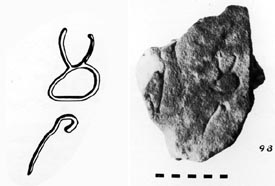
We even find better proof that El is God and not Allah by looking in the Quran. Arabic is a language of many copied words. One of them is the Arabs great patriarch Ishmael. The name Ishmael mean ?God hears?. Hmm, very interesting because in Arabic people who usually have god in their names usually reflect Allah, for example Abdallah. However with Ishmael this isn?t the case. In Arabic the last 2 letters represent EEL or EL, which is God in Hebrew. Why Hebrew, you might say? Simple, because this name is an exact copy from the Hebrew language. This shows us that Allah isn?t El because if the Arabs originally knew that the name Ishmael meant, ?God hears? then they should?ve or could?ve implemented Allah into Ishmael. This along with the knowledge that the Arabs called God ?EL? before Allah came on the scene lets us know that EL can be used as God in Arabic. History shows this case but yet disproves Allah. Read these verses from the Arabic Quran and notice how EL in IshmaEL ?God hears? is present strong and well.
2.127 PICKTHAL: And when Abraham and Ishmael were raising the foundations of the House,(Abraham prayed): Our Lord! Accept from us (this duty). Lo! Thou, only Thou, art the Hearer, the Knower.
2:127.Wa-ith yarfaAAu ibraheemu alqawaAAida mina albayti wa-ismaaaEELu rabbana taqabbal minna innaka anta alssameeAAu a1AAa1eemu.
2.133 PICKTHAL: Or were ye present when death came to Jacob, when he said unto his sons: What will ye worship after me? They said: We shall worship thy god, the god of thy fathers, Abraham and Ishmael and Isaac, One Allah, and unto Him we have surrendered.
2:133.Am kuntum shuhadaa ith hadara yaAAqooba almawtu ith qa1a libaneehi ma taAAbudoona min baAAdee qaloo naAAbudu i1ahaka wa-ilaha aba-ika ibraheema wa-ismaaaEELa wa-ishaqa i1ahan wahidan wanahnu lahu muslimoona.
2.136 PICKTHAL: Say (0 Muslims): We believe in Allah and that which is revealed unto us and that which was revealed unto Abraham, and Ishmael, and Isaac, and Jacob, and the tribes, and that which Moses and Jesus received, and that which the prophets received from their Lord. We make no distinction between any of them, and unto Him we have surrendered.
2:136. Qooloo amanna biAllahi warna onzila ilayna wama onzila ila ibraheema wa-ismaaaEELa wa-ishaqa wayaAAqooba waal-asbati wama ootiya moosa waAAeesa warna ootiya alnnabiyyoona min rabbihim la nufarriqu bayna ahadin minhum wanahnu lalm muslimoona.
2.140 PICKTHAL: Or say ye that Abraham, and Ishmael, and Isaac, and Jacob, and the tribes were Jews or Christians? Say: Do ye know best, or doth Allah? And who is more unjust than he who hideth a testimony which he hath received from Allah? Allah is not unaware of what ye do.
2:140.Am taqooloona inna ibraheema wa-ismaaaEELa wa-ishaqa wayaAAqooba waal-asbata kanoo hoodan aw nasara qul aantum aAAlamu ami Allalm waman athlamu mimman katama shahadatan AAindahu mina Allahi warna Allahu bighafilin AAamma taAAmaloona.
3.84 PICKTHAL: Say (0 Muhammad): We believe in Allah and that which is revealed unto us and that which was revealed unto Abraham and Ishmael and Isaac and Jacob and the tribes, and that which was vouchsafed unto Moses and Jesus and the prophets from their Lord. We make no distinction between any of them, and unto Him we have surrendered.
3:84.QuI amanna biAllahi warna onzila AAalayna warna onzila Aaala ibraheema wa-ismaaaEELa wa-ishaqa wayaAAqooba waal-asbati warna ootiya moosa waAAeesa waalnnabiyyoona min rabbihim la nufarriqu bayna ahadin minhum wanahnu lahu muslimoona.
4.163 PICKTHAL: Lo! We inspire thee as We inspired Noah and the prophets after him, as We inspired Abraham and Ishmael and Isaac and Jacob and the tribes, and Jesus and Job and Jonah and Aaron and Solomon, and as We imparted unto David the Psalms;
4:163.1nna awhayna ilayka kama awhayna ila noohin waalnnabiyyeena min baAAdihi waawhayna fla ibraheema wa-ismaaaEELa wa-ishaqa wayaAAqooba waal-asbati waAAeesa waayyooba wayoonusa waharoona wasulaymana waatayna dawooda zabooran.
6.86 PICKTHAL: And Ishmael and Elisha and Jonah and Lot. Each one (of them) did We prefer above (Our) creatures,
6:86.Wa-ismaaaEELa wailyasaAAa wayoonusa walootan wakullan faddaIna Aaala alAAalameena.
14.39 PICKTHAL: Praise be to Allah Who hath given me, in my old age, Ishmael and Isaac! Lo! my Lord is indeed the Hearer of Prayer.
14:39.Alhamdu fillahi allathee wahaba lee AAala alkibari ismaaaEELa wa-ishaqa inna rabbee lasameeAAu aldduAAa/-i.
19.54 PICKTHAL: And make mention in the Scripture of Ishmael. Lo! he was a keeper of his promise, and he was a messenger (of Allah), a prophet.
19:54.Waothkur fee alkitabi ismaaaEELa innalm kana sadiqa alwaAAdi wakana rasoolan nabiyyan.
21.85 PICKTHAL: And (mention) Ishmael, and ldris, and Dhu'l-Kifl. All were of the steadfast.
21:85.Wa-ismaaaEELa wa-idreesa watha alkifli kullun mina alssabireena.
38.48 PICKTHAL: And make mention of Ishmael and Elisha and Dhu'l-Kifl. All are of the chosen.
38:48.Waothkur ismaaaEELa wa-ilyasaAAa watha alkitli wakullun mina al-akhyari
Here is what Mr. Qahwash, an Arabic expert said to me about the EE in IshamEL:
thank you for your message
I like to say that as it is on the page "Transliteration Table" we used AA for the letter # 18 in Arabic which is ayn . the ee is for the vowel ya/.it is pronounced as in feet. Also I did not translate the text but rather transliterate it. so it is like Arabic but in English letters. thank you again.
salam.
Therefore the EE in Ishmael in the Arabic Quran doesn?t read as IL (god root in Arabic) but EEL which is similar to EL in Hebrew. Note: Ishmael means ?GOD HEARS? in Hebrew with the EL being God. This same word is copied right into the Arabic text. This information is very incriminating against Islamic arguments since Ishmael is a much older name than Arabic and isn't transliterated as Ishmallah or Ishmabdallah. Now we will move to the next section.
"Allah", One true God because in Arabic Bible?
Muslims love to use this argument about Allah being in the Bible due to the fact that his name is in the Arabic bible. This is a bogus defense since the Arabic was composed after Islam, when Muhammad promoted Allah to the universal God of Abraham. If Muslims are to prove to us that Allah is the God of Abraham, then they must show us an Arabic bible before Islam. Also which Allah was Muhammad talking about? It wasn't the God of Abraham, since we have already seen that the deity of him and his tribe were Hubal.
Allah in Arabic means "THE GOD" not God. Al = The in Arabic. Just ask any Arabic linguist. Elohim in Hebrew isn?t equal to ?The God? that would have a "HA" in front of it. Basically we find that "ILAH" is God in Arabic not just Allah which is ?The God.? Muslim scholars like Muhammad Pickthall recognized this and he in his translation of the Quran says that there IS NO CORRESPONDING ENGLISH WORD FOR ALLAH. ILAH IS USED AS GOD!!!
Also Muslims make another fallacy by saying "THE WORD ALLAH DID INDEED EXIST IN THE ARABIC TALMUD AND OTHER JEWISH HOLY SCRIPTURES". If this existed in the Arabic Talmud along with the other Holy scriptures, this doesn't have any affect on the HEBREW SCRIPTURES. Basically what they are saying is that Allah is in the bible because the Arabs used it for God. I don?t know how someone can promote this argument and then claim that Allah is in the Bible which was revealed in Hebrew and Greek. One Muslim argument is:
Because Allah is in TODAY'S Arabic bible doesn't mean that the Arabs originally used this name for God. This is an assumption used by Muslims who can't since he can?t present you with any type of evidence to show a Arabic Bible with Allah in it from that time. I don?t doubt that Christian Arabs named their kids Abdallah, but what exactly does this have to do with Allah being the original name of God in Arabic as well as being the God of Abraham, Isaac, and Jacob? Nothing. This is getting off the point because it doesn't answer the question as to what name was used for God first.
Yet the problem arises from the fact that Muslims insist that Allah is not a title, but the personal name of the God of Islam. This becomes problematic since according to the Holy Bible the name of the God of Abraham is Yahweh/Jehovah, not Allah:
Exodus 6:2-3
Since we have already seen that Abraham never used the name of Allah, nor was Allah the first name in Arabia but EL, here is the Hebrew word for God in Arabic. Elohim=
A l h ee m
Muslims may claim that Allah is spelled with the Alef and the Lam, but this is the definite article added to ILAH which has a ALef with a Hamzah. If AL was the Same as IL as Muslims claim then there would be no need for the Hamazah but just the Alef by itself.
Steve Van Nattan Comments: I have on file correspondence between Samuel Zwemmer and Van Dyke, who translated the Bible into Arabic in about 1920, and Van Dyke was not happy with Allah as the name for Jehovah. But, he did not know any other name to use. Since then Samuel Zwemmer has stated in has later books that Allah is NOT the name of the God of the Bible. Both men were highly degreed, Zwemmer from Princeton. so, the translator of the Bible in Arabic did not like the name Allah.
"Allah", God of the Muslims?
In the Quran we see information about the idea of being a Muslim. Islam claims to be the final revelation to mankind from God so now lets look at the word Muslim in closer context:
S. 12.101 "O my Lord! Thou hast indeed bestowed on me some power, and taught me something of the interpretation of dreams and events,- O Thou Creator of the heavens and the earth! Thou art my Protector in this world and in the Hereafter. Take Thou my soul (at death) as one submitting to Thy Will (as a Muslim), and unite me with the righteous."
S. 33.35 For Muslim men and women,- for believing men and women, for devout men and women, for true men and women, for men and women who are patient and constant, for men and women who humble themselves, for men and women who give in charity, for men and women who fast, for men and women who guard their chastity, and for men and women who engage much in Allah's remembrance,- for them has Allah prepared forgiveness and great reward.
S. 51.36 But We found not there any, except one Muslim household:
The word Muslim means submission. One word used in the Quran to describe Abraham is Hanif, lets look at the historical information
in the Qur'an, the sacred scripture of Islam, an Arabic designation for true monotheists (especially Abraham) who were not Jews, Christians, or worshipers of idols. The word appears to have been borrowed from a Syriac word meaning "HEATHEN" and, by extension, designating a Hellenized person of culture. There is no evidence that a true hanif cult existed in pre-Islamic Arabia, but there were certain individuals who, having repudiated the old gods, prepared the way for Islam but embraced neither Judaism nor Christianity. In this sense, some of Muhammad's relatives, contemporaries, and early supporters were called hanifs--e.g., Waraqah ibn Nawfal, a cousin of the Prophet's first wife, Khadijah, and Umayyah ibn Abi as-Salt, an early 7th-century Arab poet. (http://www.britannica.com/bcom/eb/article/2/0,5716,39952+1+39144,00.html?query=hanif)
The word Hanif used for true monotheist actually means Heathen, or a worshipper of false gods!!! Not only does this verify that Muhammad's tribe were heathens but it also blasphemes Abraham who is called a Hanif, while he worshipped Yahweh Elohim the God of the Bible! This is simply unbelievable!! After embarking on a long historical journey we see that the name Allah was used to describe Baal, was never monotheistic, that El was spoken of as God first and that Hanif actually means a heathen. We also saw that Muhamamd was a shaman soothsayer and not a prophet but a man bewitched. This shows the true essence of Islam, a cannoization of paganism. I will leave you with the words of Muhammad
Sunan Abu-Dawud Book 3, Number 1092:
Narrated Abdullah ibn Mas'ud:
When the Apostle of Allah (peace_be_upon_him) addressed, he would say: Praise be to Allah, from Whom we seek help and pardon,and we seek refuge in Allah from the evils of our souls. He whom Allah guide has no one who can lead him astray, and he whom He leads astray has no one to guide him. And I bear witness that there is no god but Allah, and I bear witness that Muhammad is His servant and apostle. He sent him before the coming of the last hour with truth giving good tidings and warning. He who obeys Allah and His Apostle follows the right path; and he who disobeys them shall harm none except himself, and he will not harm Allah in the least.
And
Need we say more? No.
APPENDIX
Most of the cuneiform text have been posted here. The majority especially the signs dealing with AN, IL in relation to Allah along with Enlil and Baal have been posted. I apologize for the rest not being able to be put on but in the future this should change. It will take time to scan and download them. When new information become available, this paper will be updated. This paper is by no ways finished.
After reading this paper you will clearly see that Allah wasn't originally known as the God of Abraham and that Muhammad is a self-proclaimed prophet. The Cuneiform text speaks for themselves in showing the origin of IL in Allah to be from the god An. Peace be unto all.